

llms.txt, AI crawlers, GPTBot, OAI-SearchBot, robots.txt AI bots, AI crawler access

For most industrial companies, llms.txt is optional. As of the time of writing, it remains a proposed navigation file for AI-oriented consumers, not an access-control standard, a ranking signal, or a requirement for AI search visibility. Google Search explicitly says it ignores llms.txt: having the file neither helps nor harms visibility or rankings.
The more consequential work is deciding which crawlers may reach the public site, aligning robots.txt with CDN and firewall rules, keeping important content accessible in HTML, and verifying the result. This guide gives IT, marketing, and legal teams a shared framework for doing that without treating every “AI bot” as the same thing.
For definitions of AEO, LLMO, AI Overviews, and related terms, begin with our GEO glossary.
- Four layers teams often confuse
- What llms.txt actually is
- AI crawlers have different jobs
- Build a purposeful robots.txt policy
- Robots.txt declares; infrastructure enforces
- Verify access in logs—not assumptions
- Make fetched pages understandable
- A one-page governance policy
- What crawlability work looks like in practice
Four layers teams often confuse
llms.txt, robots.txt, and a firewall do different jobs. A fourth layer—page rendering—determines whether an allowed visitor can extract anything useful.
Visual: the access stack
| Layer | What it does | What it cannot do |
| llms.txt | Offers an optional curated content map | Grant access, block bots, or improve Google rankings |
| robots.txt | Declares crawler preferences by product token | Secure confidential content or stop noncompliant bots |
| CDN/WAF | Allows, challenges, rate-limits, or blocks requests | Make thin or script-hidden content understandable |
| Page delivery | Exposes text, links, and files in a fetchable response | Override an upstream block or noindex directive |
A deliberate program reviews all four. Publishing llms.txt while the CDN blocks search crawlers is ineffective. Allowing every bot while essential specifications load only after a fragile browser interaction also misses the point.
What llms.txt actually is
The llms.txt proposal suggests placing a Markdown file at /llms.txt. The file introduces the site and links to selected resources, sometimes including Markdown versions intended to be easier for language-model tools to consume.
It remains a proposal, not a W3C or IETF standard. It has no enforcement mechanism, and support varies by product and workflow. Developer-documentation platforms and coding tools may use it, which can make it worthwhile for API references or large technical documentation sets. That is different from proving that it improves brand citations in consumer AI search.
Google’s current position is unambiguous. Its AI optimization guide says Google Search ignores llms.txt and does not require new AI text files for AI Overviews or AI Mode. A file may still serve another system that chooses to read it, but it is not a Google Search lever.
A maintainable llms.txt example
# Example Pump Co.
> Industrial pump manufacturer serving corrosive-fluid applications.
## Product families
– [Series 400 pumps](https://www.example.com/products/series-400/): Materials, performance range, and model links
– [Sanitary pump line](https://www.example.com/products/sanitary/): Hygienic applications and certifications
## Technical resources
– [Pump selection guide](https://www.example.com/resources/pump-selection/): Sizing and specification process
– [Chemical compatibility](https://www.example.com/resources/compatibility/): Material guidance by fluid
## Company
– [Capabilities](https://www.example.com/capabilities/): Engineering, testing, and support
If you publish the file, generate or validate it against the canonical site structure. Link only to public, current pages; use concise descriptions; return a normal 200 response; and assign an owner. A stale manifest is not “cheap insurance.” It is another public artifact that can contradict the site.
Windmill’s recommendation
For a typical industrial marketing site, do not prioritize llms.txt ahead of crawlability, indexability, HTML content, internal links, structured data, and measurement. Consider it when all three conditions are true:
- A known audience or tool can use the file.
- The site has a substantial, well-structured documentation library.
- The file can stay synchronized automatically or through a defined publishing workflow.
Otherwise, record the decision and revisit it as platform support changes. Do not buy an “llms.txt generator” expecting ranking or citation gains that vendors cannot substantiate.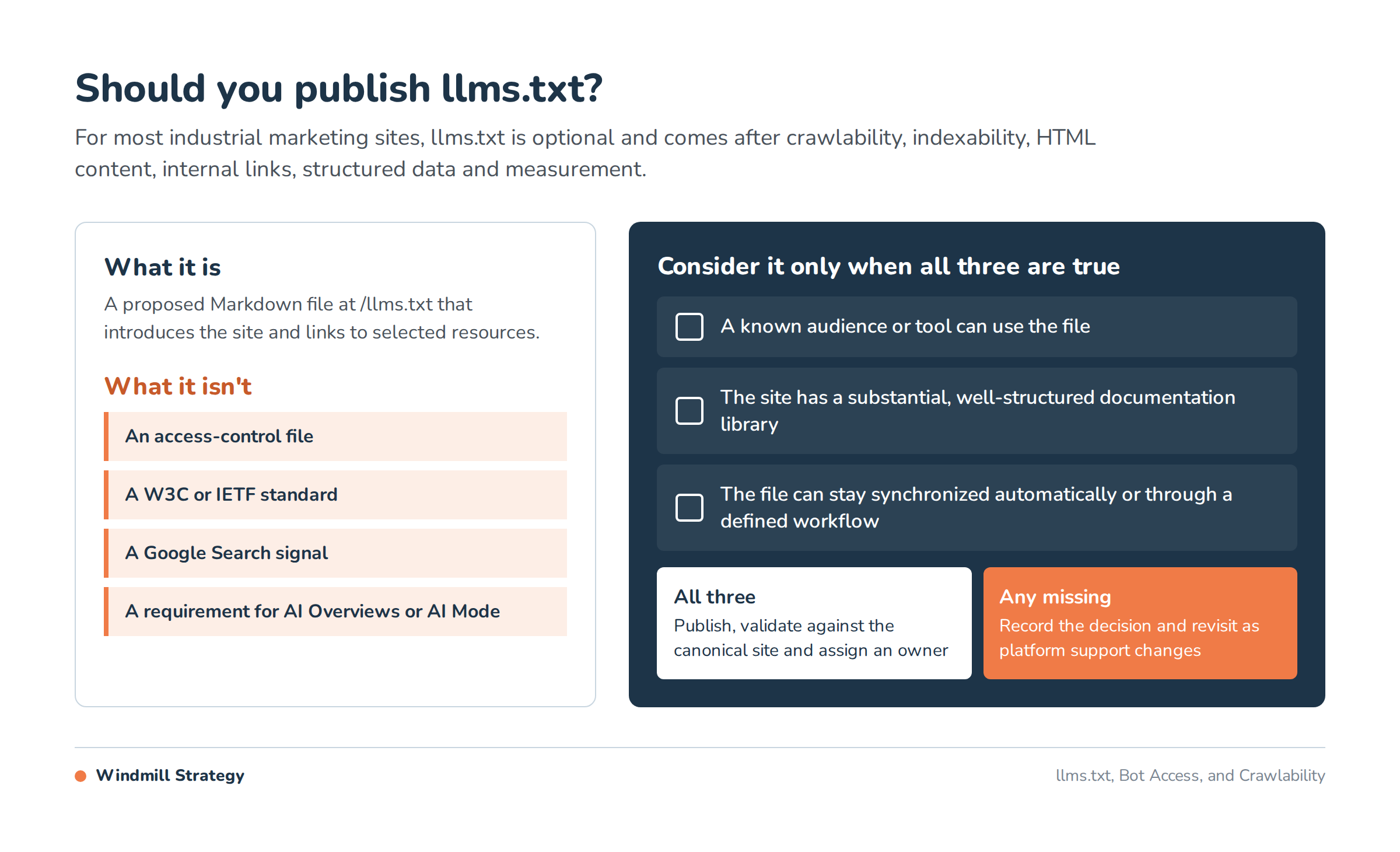
AI crawlers have different jobs
An AI company may operate separate systems for model training, search indexing, and a user’s live request. Policies should be based on purpose, not the vendor’s name alone.
Visual: crawler decision matrix
| Provider | Product token | Primary purpose | Practical policy question |
| OpenAI | OAI-SearchBot | ChatGPT search results | Do we want public pages eligible for discovery? |
| OpenAI | GPTBot | Potential model training | Do training benefits outweigh IP concerns? |
| OpenAI | ChatGPT-User | User-requested page visit | Can the public page be safely fetched on demand? |
| Anthropic | Claude-SearchBot | Search-result improvement | Do we want discovery in Claude search? |
| Anthropic | ClaudeBot | Model training | What is our training-use policy? |
| Anthropic | Claude-User | User-directed retrieval | Can public pages support live requests? |
| Googlebot | Google Search, including AI features | Are public pages crawlable for Search? | |
| Google-Extended | Gemini training and grounding controls | Do we permit these non-Search uses? | |
| Perplexity | PerplexityBot | Search indexing | Do we want pages discoverable in Perplexity? |
Use each provider’s current documentation, because names and behavior can change:
Two distinctions matter most.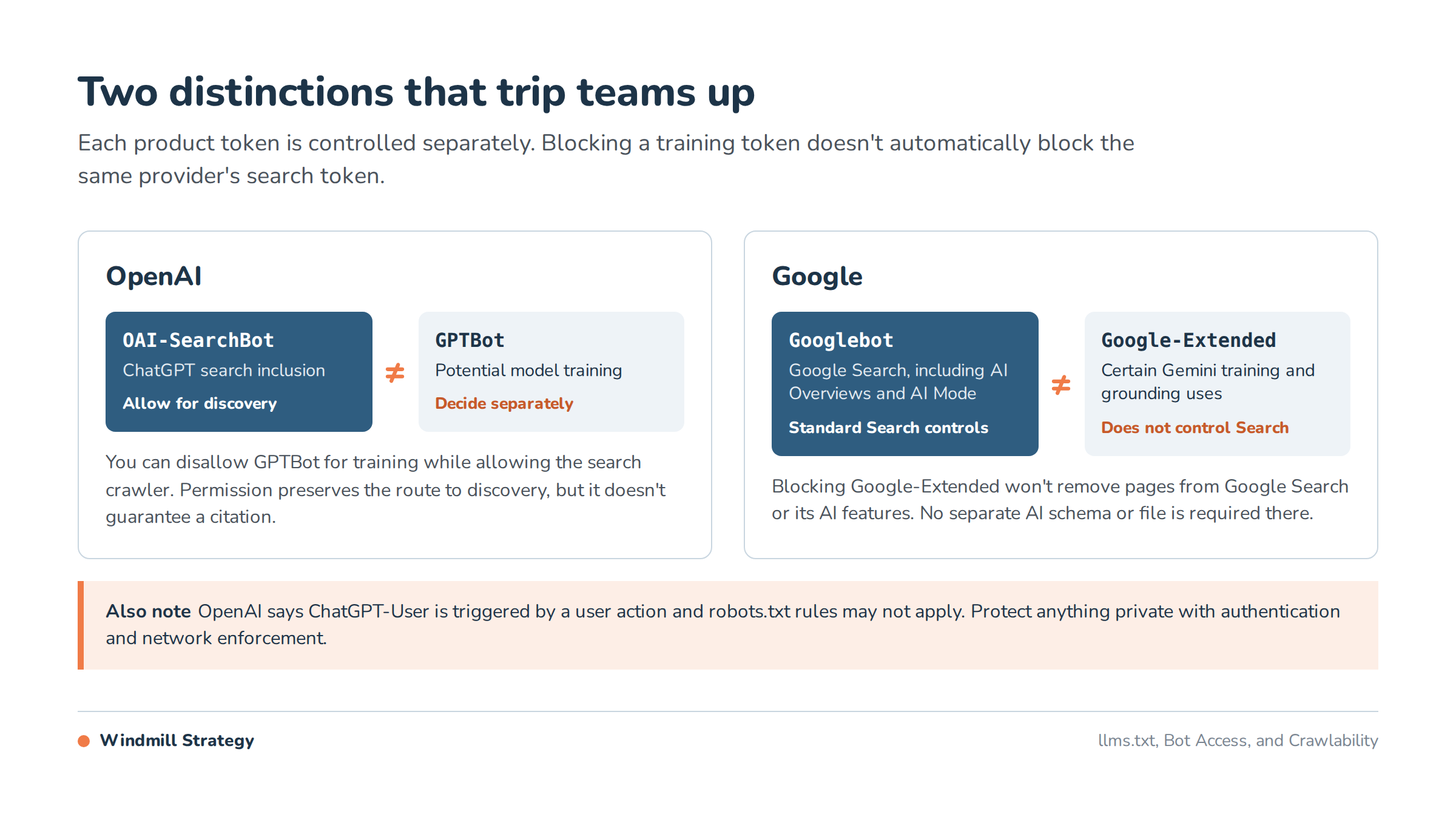
First, GPTBot is not the bot OpenAI documents for ChatGPT search inclusion; that is OAI-SearchBot. A company can disallow GPTBot for training while allowing the search crawler. This preserves the technical route for search discovery, but no crawler permission guarantees selection or citation.
Second, Google-Extended does not control Google Search. Google documents it as a standalone product token governing certain Gemini model training and grounding uses. Googlebot and standard Search controls govern pages in Google Search, including AI Overviews and AI Mode. Google’s AI feature guidance confirms that no separate AI schema or special optimization is required.
OpenAI also notes that ChatGPT-User is triggered by a user action and that robots.txt rules may not apply to it. Do not assume an Allow or Disallow line controls every user-requested fetcher. Use authentication and network enforcement for anything that must remain private.
Build a purposeful robots.txt policy
For public industrial marketing content, Windmill’s starting posture is usually:
- Allow search crawlers where discovery is desired.
- Decide training access case by case with marketing, IT, legal, and intellectual-property owners.
- Treat user-requested fetches as a security question, not only a marketing question.
- Protect private content through authentication and infrastructure controls, never robots.txt.
Here is an illustrative policy that allows named search crawlers and declines named training uses. It is not a universal drop-in file; merge it carefully with the site’s existing rules and test it.
# AI search discovery
User-agent: OAI-SearchBot
Allow: /
User-agent: Claude-SearchBot
Allow: /
User-agent: PerplexityBot
Allow: /
# Optional training restrictions
User-agent: GPTBot
Disallow: /
User-agent: ClaudeBot
Disallow: /
User-agent: Google-Extended
Disallow: /
Do not paste this over existing directives. The live file may include Googlebot rules, sitemap declarations, environment-specific paths, or ecommerce exclusions. Validate exact product-token behavior with each provider and test representative URLs from outside the corporate network.
Blocking a training token does not automatically block the same provider’s search token. It can, however, affect how the provider may use the content outside retrieval. Leadership should own that tradeoff rather than leaving it to a plugin default.
Robots.txt declares; infrastructure enforces
Well-behaved crawlers may honor robots.txt, but the file is public and voluntary. A CDN, web application firewall, reverse proxy, or origin server is where requests are actually allowed, challenged, rate-limited, or rejected.
Cloudflare’s AI Crawl Control can show crawler activity and manage access. Its controls distinguish search, training, and agent categories. Accounts, plans, rules, and defaults can differ, so inspect the current configuration instead of assuming a global setting applies.
For each production hostname, IT should document:
- CDN or WAF bot rules, including category and custom rules.
- Managed challenges and rate limits that may catch legitimate bots.
- Origin allowlists or denylists.
- The deployed robots.txt response and status code.
- Any X-Robots-Tag, page-level robots directive, or authentication barrier.
Validate claimed crawlers against provider-published identification methods and IP ranges where available. A user-agent string alone is easy to spoof.
Verify access in logs—not assumptions
Browser checks are not enough. A normal employee browser can receive 200 while a crawler receives 403, 429, a challenge page, or a different response body.
Create a small verification sample: the homepage, a product-family page, a technical article, a PDF, and a conversion page. For each, record the response status, canonical URL, robots directives, rendered content, and relevant CDN event. Then review server or CDN logs over a meaningful period for verified crawler requests.
Absence of a bot in a short log window does not prove blocking; some crawlers visit infrequently. Test the configuration directly and use logs as supporting evidence. Human visits from cited AI answers are a separate measurement stream, covered in our AI traffic guide.
Make fetched pages understandable
Access is only the first gate. Important product data should be present in stable, indexable HTML or reliably server-rendered output. Do not assume every AI fetcher executes complex client-side JavaScript, expands hidden tabs, submits a form, or reads a scanned PDF accurately.
Prioritize:
- Descriptive titles and headings.
- HTML specification tables with units.
- Crawlable links among products, applications, and resources.
- Stable canonical URLs and useful status codes.
- XML sitemaps containing canonical, indexable pages.
- Accessible text alternatives for meaningful images.
- Structured data that matches the visible page.
Our schema guide covers the last item, while the technical content guide addresses page structure and evidence. If access, indexing, and content quality are all uncertain, use the broader AI visibility audit.
The same controls affect conventional organic visibility. Our SEO audit guide provides a companion check for indexing, page experience, metadata, content, and measurement.
A one-page governance policy
Marketing and IT can use this table as the record of decision.
| Decision | Owner | Review evidence | Cadence |
| Search crawler access | Marketing + IT | Provider docs, live tests, logs | Quarterly |
| Training crawler access | Legal + leadership | IP policy and business goals | Twice yearly |
| User-requested fetching | Security + IT | Authentication and WAF tests | Quarterly |
| CDN/WAF enforcement | IT | Exported rules and event logs | After every change |
| llms.txt publication | Content + web | Known use case and link audit | Each release |
| HTML accessibility | Web + marketing | Fetch/render sample | Each template change |
Document exceptions by path. Public product information, gated customer portals, distributor resources, and pre-release technical documents should not inherit the same policy accidentally.
What crawlability work looks like in practice
For Micro Weld, Windmill Strategy’s program included crawl and indexation fixes, structured data, measurement improvements, and a stronger content architecture. During the period reported in the Micro Weld results, organic sessions rose 129%, key events rose 180%, and first-page keywords rose 238%.
Those figures do not isolate the effect of crawler configuration. They show why crawlability belongs inside a connected program: bots need access, but the pages also need substantive content, coherent architecture, reliable measurement, and a path to conversion.
Windmill Strategy can help industrial marketing and IT teams audit crawler access, prioritize technical fixes, and establish a maintainable policy through industrial SEO services, GEO consulting, and ongoing website maintenance. Talk with our team to plan the review.