

Schema Markup for Manufacturers: A Practical Guide

Schema markup is machine-readable data that identifies the subject of a page and describes its attributes. Product schema can identify facts such as a product’s name, manufacturer, model number, material, and specifications. For manufacturers, it can reduce ambiguity around complex product families and make pages eligible for certain Google search features when they meet Google’s requirements.
It cannot guarantee an AI citation, a ranking, or a rich result. Google now says this plainly: its generative AI search features use the same foundations as Google Search, require nospecial AI schema, and do not require a new machine-readable file. See Google’s AI guidance, our GEO glossary, and our AI Overviews analysis for the larger context.
That makes schema useful—but only in its proper role. It is a structured description of content that already exists on the page, not a substitute for complete technical content.
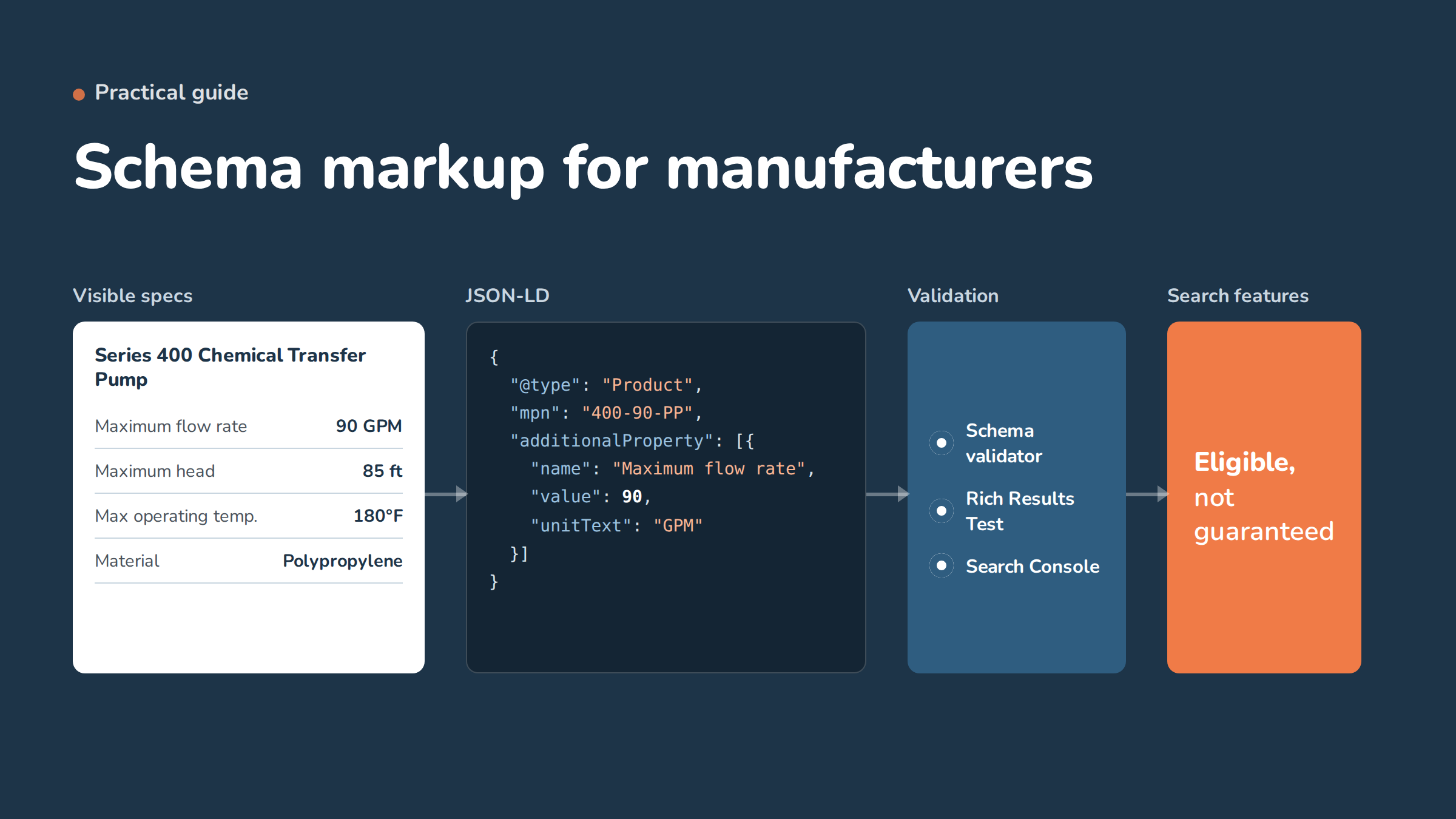
What schema does—and does not do
Schema.org provides a shared vocabulary for describing entities and their relationships. JSON-LD is the implementation format Google generally recommends because it can be generated and maintained separately from the page’s visible HTML.
For an industrial site, accurate schema can:
- Identify a page as describing a product, organization, article, or breadcrumb trail.
- Connect a product to its brand or manufacturer.
- Label identifiers and attributes consistently.
- Support eligibility for Google search features when the page satisfies the applicable documentation.
- Give parsers an explicit representation of facts that are also visible to users.
Schema does not:
- Make thin content authoritative.
- Cause an AI engine to cite the page.
- Put a page in Google’s index.
- Override blocked crawling, a noindex directive, or poor canonicalization.
- Turn confidential or unsupported claims into trusted facts.
Google’s current guidance is especially important here: structured data should match visible text, and generative AI features do not need their own markup. Think of schema as a clarity and eligibility layer, not a separate GEO channel.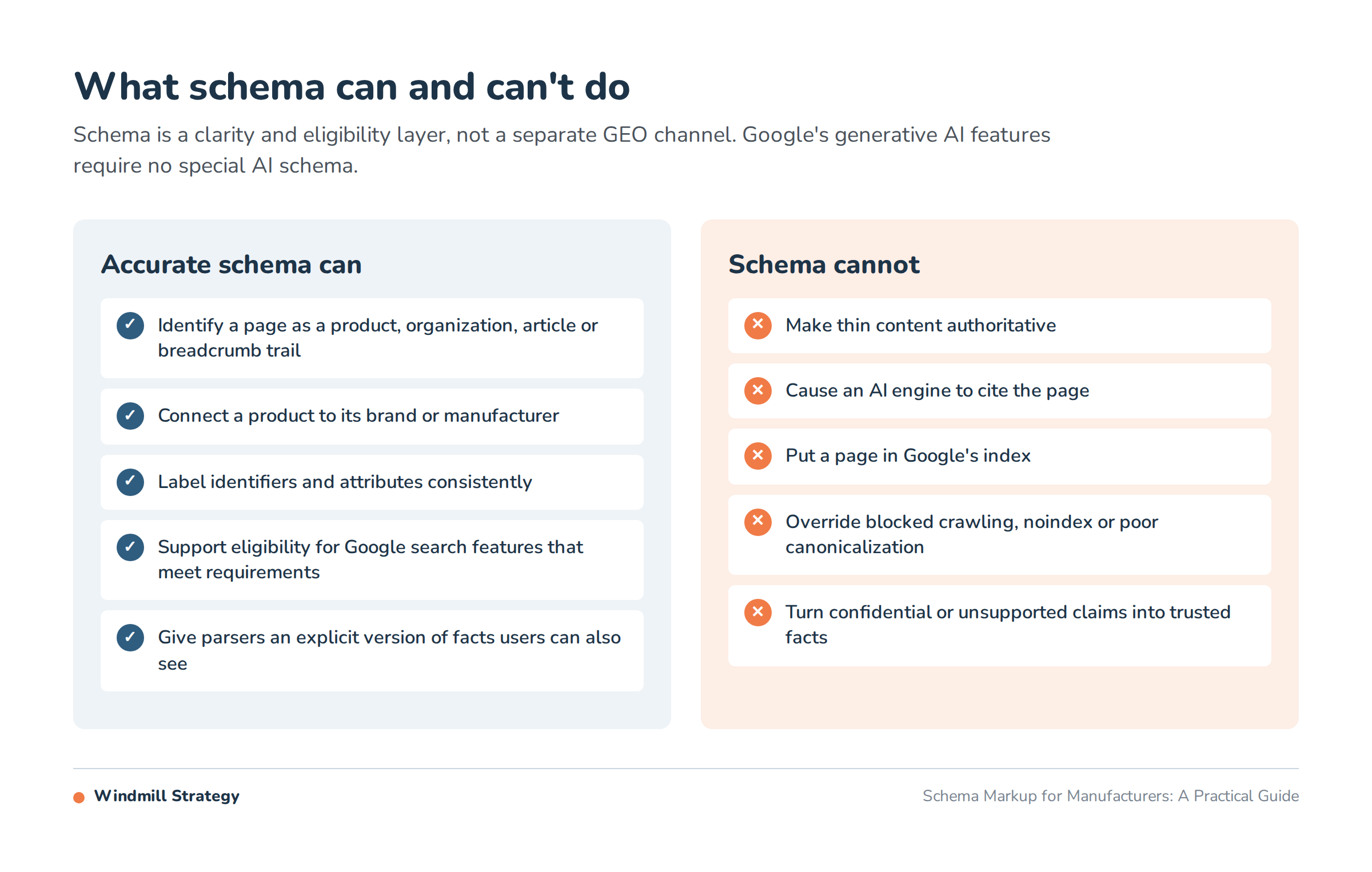
Visual: the productive schema workflow
| Layer | Team question | Deliverable |
| Visible content | Can an engineer find the fact? | Complete HTML copy and spec tables |
| Data Model | Is the fact stored consistently? | Defined fields, units, IDs, and ownership |
| JSON-LD | Can machines identify it? | Schema matching the visible page |
| Validation | Is the syntax and feature fit correct? | Clean validator and test results |
| Monitoring | Did templates or data change? | Search Console review and scheduled QA |
Choose schema by page purpose
Manufacturers often force every revenue page into Product. A better rule is to model what the page actually represents and how a buyer engages with it.
| Page type | Best starting type | Practical note |
| Defined product or model | Product | Use stable identifiers and visible specifications |
| Product family with variants | ProductGroup plus Product | Connect variants instead of duplicating one generic record |
| Purchasable item | Product plus Offer | Follow current merchant-listing requirements |
| Custom capability | Service | Better fit when buyers request a process or outcome |
| Technical article | Article or TechArticle | Include a real author, dates, and publisher |
| Company identity | Organization | Establish one reusable organization entity |
| Site hierarchy | BreadcrumbList | Match the visible breadcrumb path |
| FAQ content | Usually no priority | Google removed FAQ rich results in 2026 |
Google supports particular structured-data features and properties—not every type in the broader Schema.org vocabulary. Use Google’s product guide when product search presentation is the goal, and use Schema.org to confirm the vocabulary itself.
Product, ProductGroup, or Service?
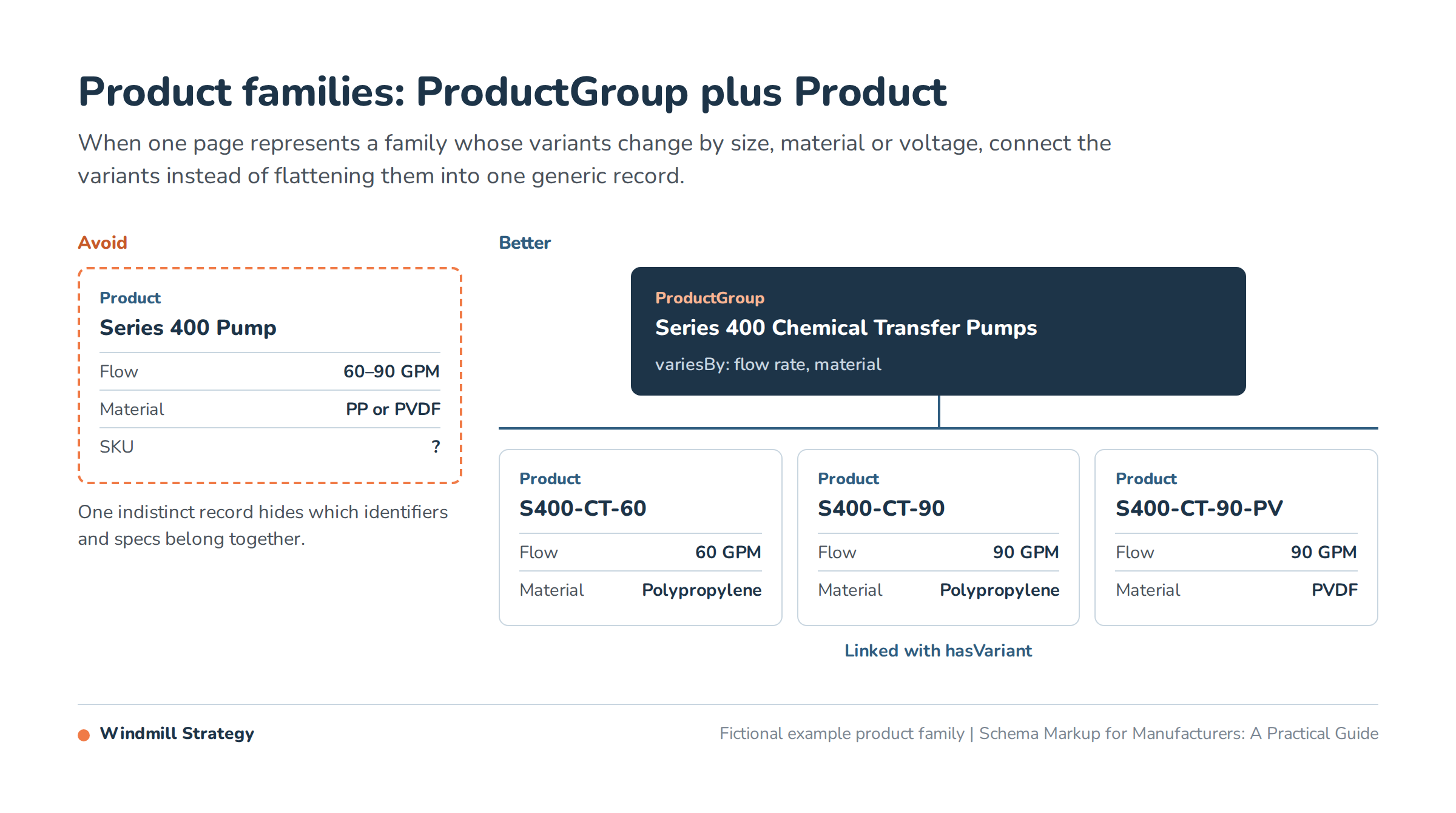
Use Product for a defined item or model with a stable identity. If one page represents a family whose variants change by size, material, voltage, or another property, evaluate ProductGroup and hasVariant rather than presenting the family as one indistinct product.
Use Service for capabilities such as precision machining, system integration, or design-for-manufacturability consulting. Service can be semantically appropriate without creating a Google rich result. That distinction prevents a common mistake: inventing a SKU, price, or inventory status for a capability page simply to satisfy a product template.
What happened to FAQPage?
Google stopped showing FAQ rich results on May 7, 2026 and subsequently removed the feature documentation. The change is recorded in Google’s search updates. Useful questions and direct answers still belong on pages when they help buyers, but FAQPage is no longer a Google rich-result tactic.
Do not delete strong FAQ content. Keep it visible, specific, and maintained. Just avoid spending implementation time on FAQ markup under the assumption that it earns an expanded Google result or AI citation.
A product schema example
This JSON-LD pattern describes a fictional, quote-based industrial pump. Each value should come from the same source used to render the visible page.
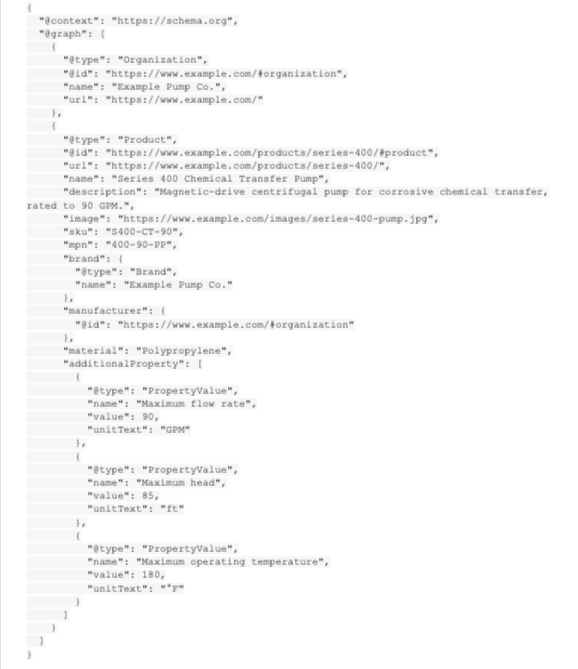
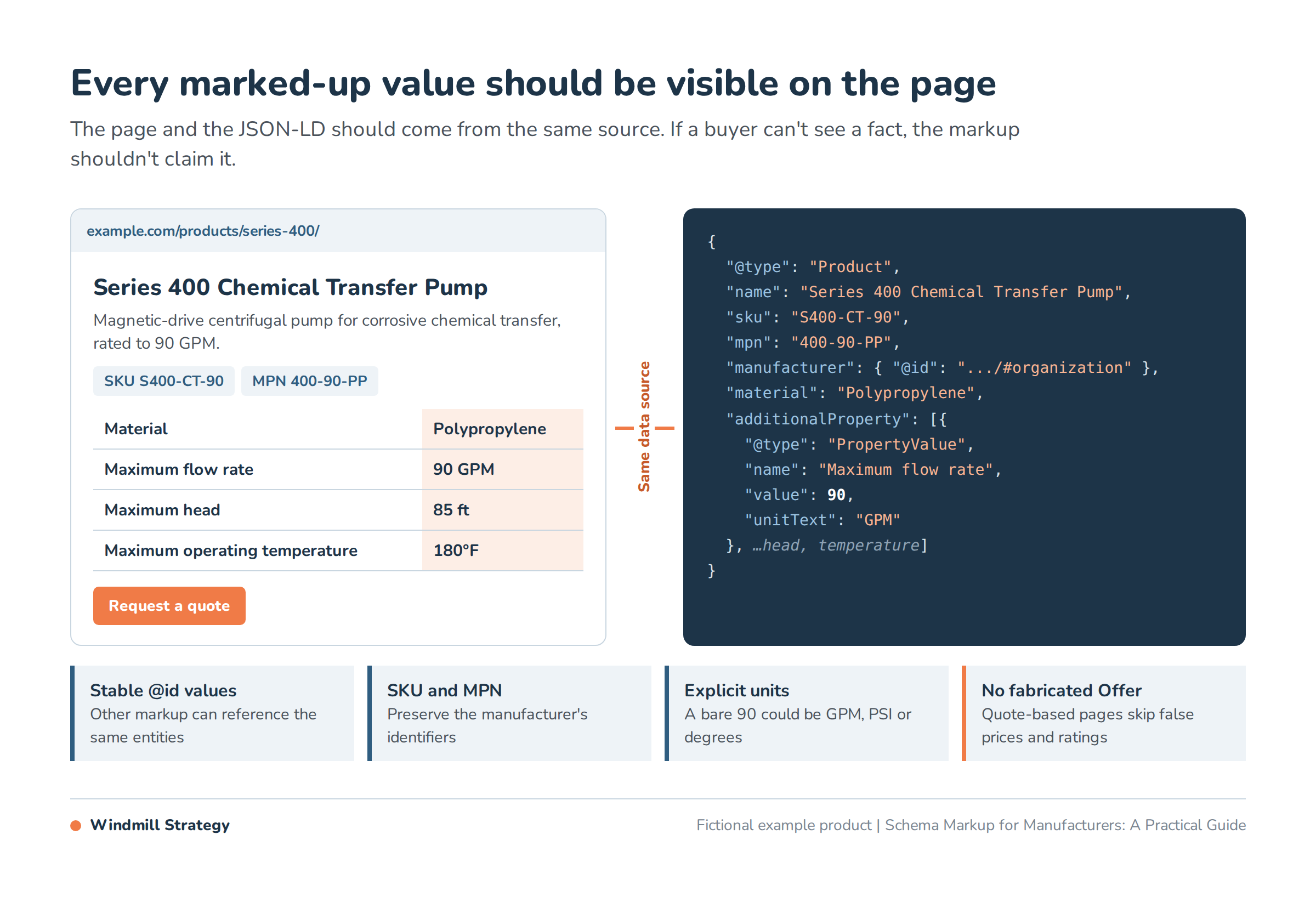
Several details make this pattern useful:
- The product and organization have stable @id values, so other markup can reference the same entities.
- sku and mpn preserve the manufacturer’s identifiers.
- additionalProperty carries named specifications with explicit units.
- The description is concise and factual rather than a block of promotional copy.
- No Offer, rating, or review has been fabricated.
This can be valid Schema.org markup without qualifying for a Google product display. Eligibility depends on the current Google feature requirements and the information a page legitimately contains. Quote-based manufacturers should not publish a false price or availability merely to complete an Offer object.
Supporting types that earn their keep
Organization
Create one authoritative Organization entity and reference it across templates. Include the public name, canonical URL, logo, appropriate contact details, and accurate sameAs identity links. Avoid treating every directory profile as an identity source; choose official, maintained profiles.
BreadcrumbList
Breadcrumb markup helps describe hierarchy and should match the breadcrumb users see. It is especially valuable on deep industrial catalogs where similar model numbers sit beneath product families and markets.
Article and TechArticle
Technical articles should identify a real author or reviewer, publication and modification dates, headline, image, and publisher. Markup cannot create expertise, but it can make genuine authorship and publishing relationships explicit. Pair it with a byline, a credible bio, revision practices, and cited evidence.
WebSite and WebPage
These types can describe the site and individual pages, but plugins frequently generate them already. Audit before adding custom blocks; two plugins and a theme can create conflicting entities.
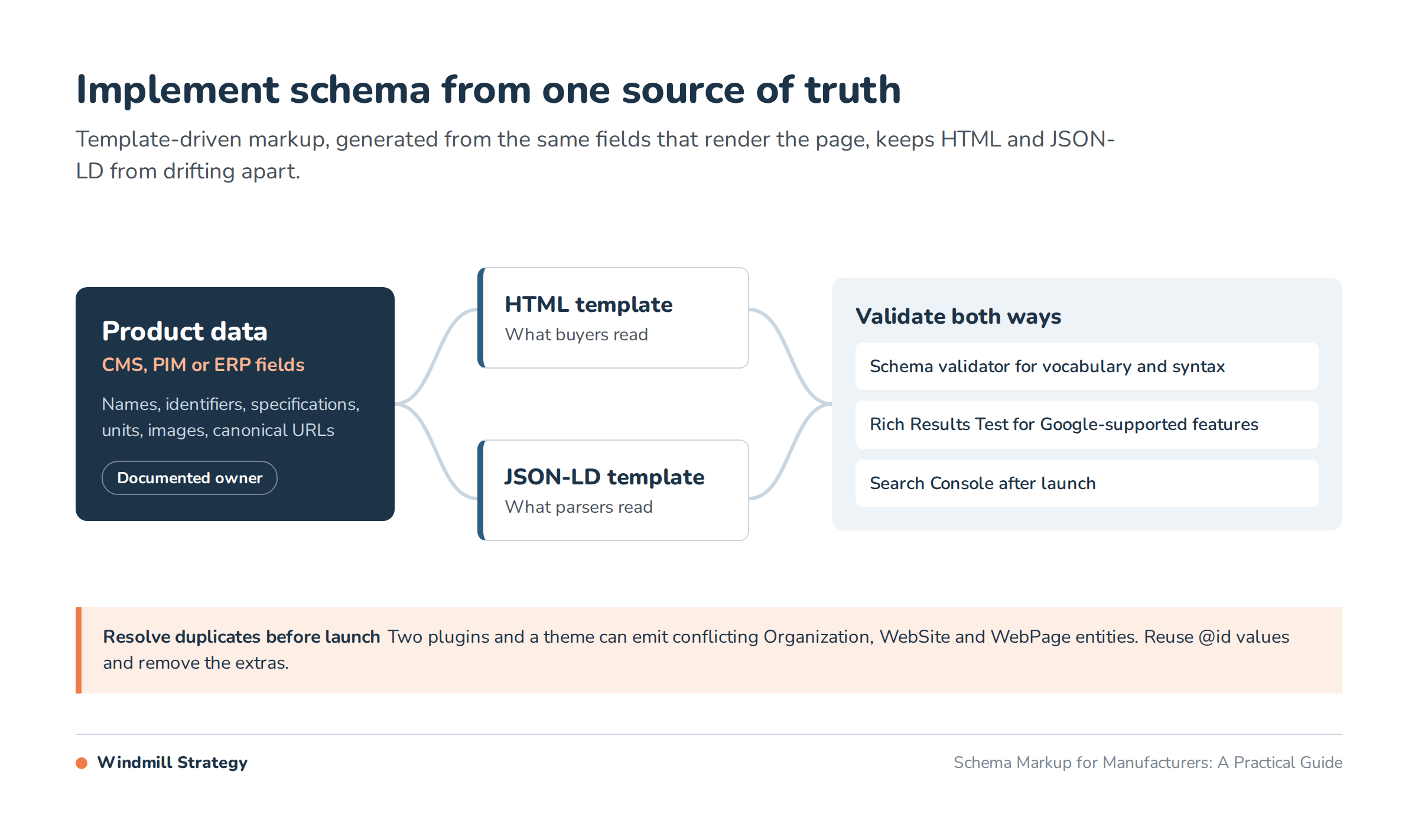
Implement schema from one source
The strongest implementation is template-driven, not hand-coded page by page.
- Inventory page types. Separate products, product families, capabilities, resources, locations, and company pages.
- Map visible fields. Document where names, identifiers, specifications, units, images, and canonical URLs originate.
- Fix the HTML. Move essential facts out of images, downloads, or interaction-dependent widgets. Check the related crawlability guide for access and rendering considerations.
- Generate JSON-LD. Populate templates from CMS, PIM, or ERP fields whenever possible.
- Resolve duplicates. Reuse @id values and remove conflicting plugin, theme, or custom output.
- Validate both ways. Use the Schema validator for vocabulary and syntax, then the Rich Results Test for Google-supported features.
- Monitor after launch. Review applicable Search Console reports, inspect representative URLs, and retest after template or plugin changes.
If the site has inconsistent templates or unclear indexing, start with an AI visibility audit rather than adding markup blindly.
Common schema mistakes
- Marking up hidden facts. The structured data must describe what users can verify on the page.
- Using the wrong type. A capability is not automatically a product, and a product family is not always one SKU.
- Inventing commercial data. False prices, availability, reviews, and ratings create policy and trust problems.
- Dropping units. A bare value such as 90 is meaningless when the specification could be GPM, PSI, millimeters, or degrees.
- Publishing stale markup. Discontinued models and changed specifications must update in both HTML and JSON-LD.
- Creating duplicate entities. Conflicting names, URLs, logos, and IDs weaken clarity.
- Counting warnings as success. “Valid” syntax does not mean the content is accurate or eligible for a search feature.
- Measuring schema alone. Rankings and citations reflect many systems; avoid attributing movement to one technical change without evidence.
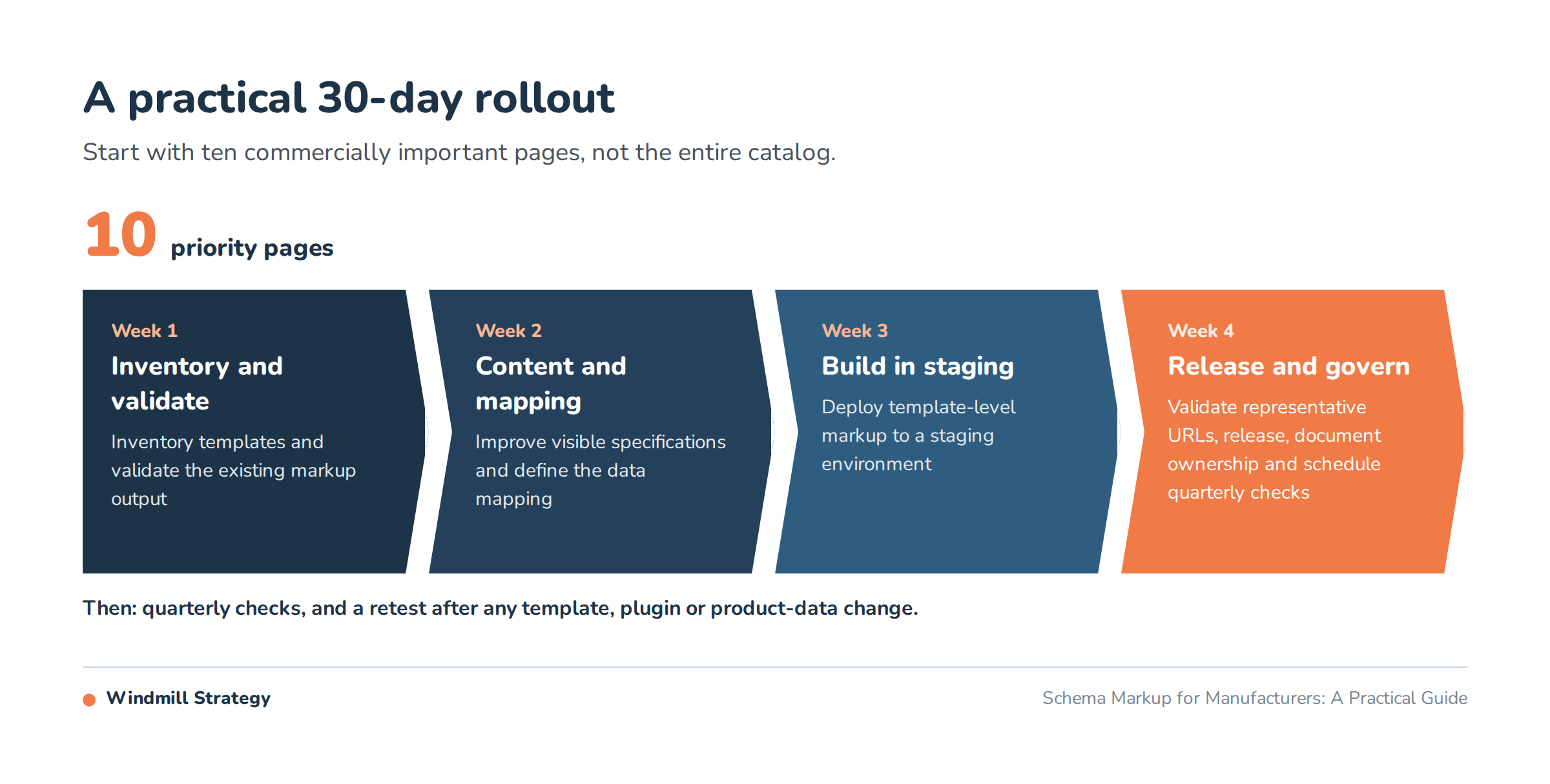
A practical 30-day rollout
Start with ten commercially important pages, not the entire catalog. During week one, inventory templates and validate the existing output. In week two, improve visible specifications and define the data mapping. In week three, deploy template-level markup to a staging environment. In week four, validate representative URLs, release, document ownership, and schedule quarterly checks.
| Check | Pass condition |
| Page purpose | Schema type matches buyer intent |
| Visible facts | Every marked-up claim appears on-page |
| Identifiers | SKU, MPN, URLs, and @id values are stable |
| Specifications | Names, values, and units are complete |
| Feature fit | Google requirements are checked separately |
| Governance | Data owner and review cadence are documented |
This work is most effective as part of broader industrial SEO services or a coordinated GEO program, because content quality, indexing, internal links, authority, and measurement still determine whether strong pages are discovered and trusted.
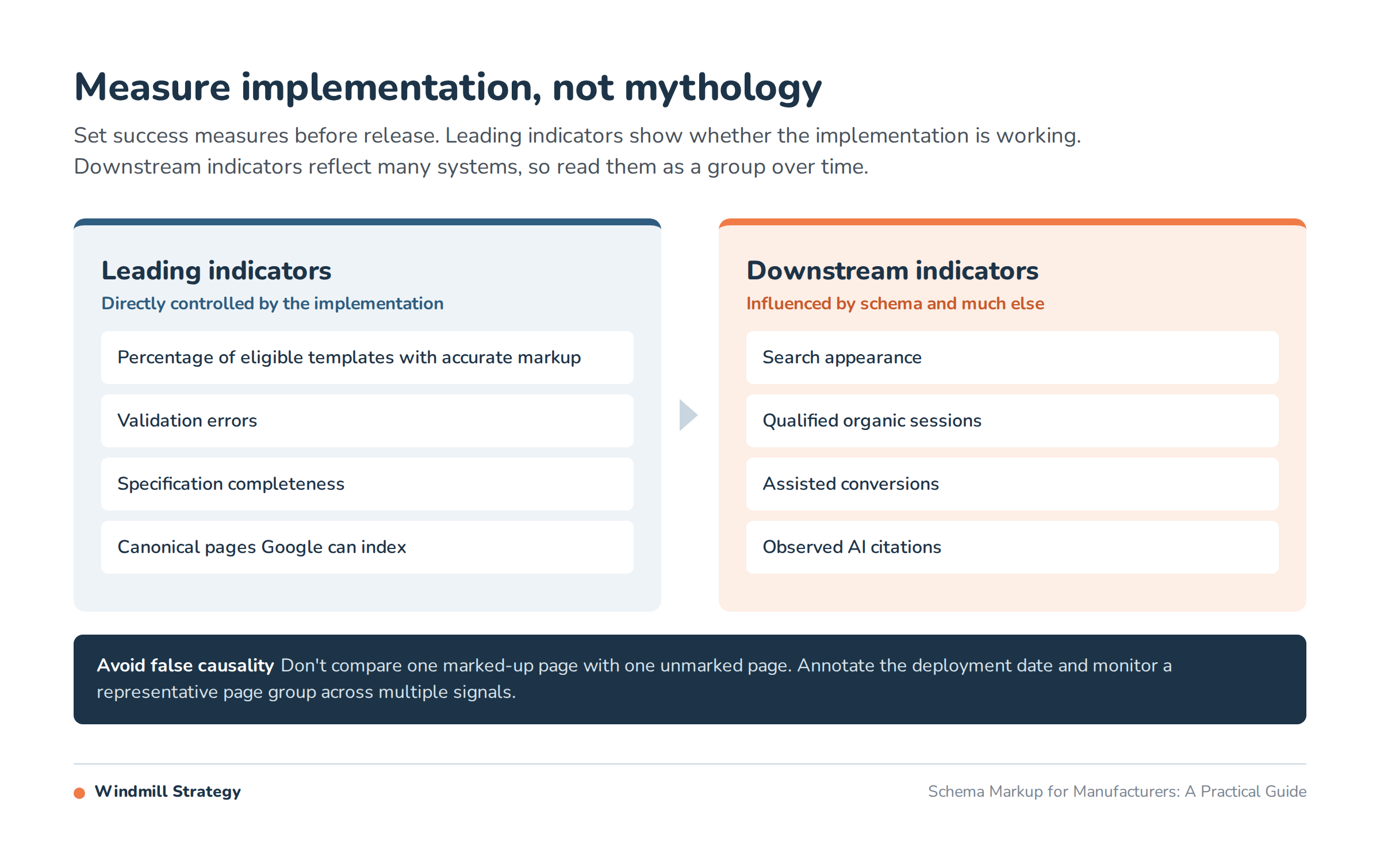
Measure implementation, not mythology
Set success measures before release. Leading indicators include the percentage of eligible templates with accurate markup, validation errors, specification completeness, and the number of canonical pages Google can index. Search appearance, qualified organic sessions, assisted conversions, and observed AI citations are downstream indicators.
Do not compare one marked-up page with one unmarked-up page and call the difference causal. Product demand, query mix, links, content depth, seasonality, and search-system changes all intervene. Annotate the deployment date, monitor a representative page group, and review multiple signals over time. The related AI traffic guide explains how to separate identifiable AI referrals from citation monitoring; neither dataset is complete on its own.
What a real implementation looks like
Windmill Strategy’s work for Panel Built combined structured data with product and category content, internal linking, and other technical SEO improvements. In the period reported in the Panel Built case study, the site appeared in nearly 600 AI Overviews, ChatGPT referrals rose 61% year over year, organic contact forms rose 122%, dealer forms rose 600%, and file downloads rose 206%.
Those results should not be assigned to schema alone. They illustrate the larger point: structured data is valuable when it is one part of a complete system—technically sound pages, useful product information, clear relationships, strong internal pathways, and ongoing measurement.
If your product data is trapped in PDFs, duplicated across templates, or emitted by conflicting plugins, Windmill Strategy can help prioritize the fix and build an implementation your team can maintain. Talk with our team about an industrial schema and search-readiness plan.