


When Your Buyers Ask AI, Ensure Your Brand is the Answer
We help your company surface accurately when buyers ask ChatGPT, Perplexity, Google AI Overviews, and Gemini for vendors, comparisons, and recommendations.
Buyer behavior is changing faster than most B2B marketing strategies can keep up. Engineers, specifiers, and technical buyers now turn to AI tools for vendor shortlists, product comparisons, and early-stage research before they ever visit a website. When your company is missing, misrepresented, or outranked in those answers, you lose visibility at the exact moment buyers are shaping their consideration set.
GEO Services for B2B Industrial and Technical Brands
GEO is not traditional SEO with a new acronym. It requires a focused strategy for how your expertise is structured, cited, and reinforced across the trusted sources AI platforms rely on. We evaluate how your brand appears today, identify gaps in visibility and accuracy, and build the content, authority signals, and technical foundation needed to help AI systems recognize your company as a credible answer.
Partner with a B2B GEO Marketing Agency That Tells You the Truth
When a design engineer, plant manager, or sourcing lead asks ChatGPT to recommend a supplier, they get a handful of names. As your B2B GEO marketing agency, we’ll help make sure yours is one of them, and that the description is accurate when it shows up.
What Generative Engine Optimization Actually Is
GEO, AEO, AIO… whatever the acronym turns out to be, we’re experts at making your brand visible wherever your customers are searching.
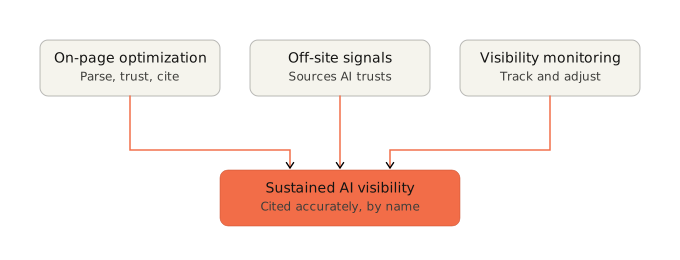
A complete GEO program isn’t a single tactic. It’s three connected workstreams that build on each other.
01. On-Page Optimization
The SEO fundamentals AI discoverability is built on, plus AI-specific structuring that helps language models parse, trust, and cite what’s on your site.
02. Off-Site Brand Signals
We use our tools and data to identify the specific publications, directories, social platforms, forums, and communities AI models actually pull from and where your target audience is researching. This strategic identification of key outlets is the first step. We provide the data-driven roadmap, ensuring your team’s outreach and placement efforts are focused precisely where they matter most.
03. Visibility Monitoring
Ongoing observation across ChatGPT, Google AI Overviews, Gemini, and Microsoft Copilot. We watch how often your brand surfaces, how it’s characterized, and where competitors are pulling ahead.
SEO and GEO for B2B: Where the Fundamentals Carry Over, and Where New Skills Take Over
Here’s the honest version. A large share of GEO is traditional SEO doing its job. Crawlability, semantic structure, clean architecture, and authoritative content all matter, because language models lean on the same web ecosystem that powers Google (and Bing). The fundamentals you’ve already invested in still carry real weight, and that’s work we’ve done for B2B and industrial clients for years.
But GEO is not just SEO with a new name. AI systems read, weight, and cite content differently than search engines rank it. Earning a citation in ChatGPT or Perplexity calls for skills the traditional SEO playbook never covered: prompt-to-content mapping, section-level optimization, citation-pattern analysis across engines, and off-site signal building tuned to what models actually pull from. Those are genuinely new skills, and we’ve been intentionally building them inside Windmill. We test across engines, track what gets cited in B2B technical categories, and turn those patterns into repeatable work for our clients.
That combination is the core of our B2B GEO consulting: the SEO discipline you’d expect from an established agency, paired with the newer GEO skill set most agencies are still scrambling to build.
On-Page GEO: The SEO Fundamentals Still Matter for AI Visibility
On-page
Language models lean heavily on the same web ecosystem that powers traditional search. Weak SEO fundamentals limit your AI search visibility before you even start. Our on-page work covers:
- Bot Rendering & Crawlability
Resolve the rendering gaps, bot blockers, and access issues that prevent GPTBot, PerplexityBot, ClaudeBot, and Google-Extended from reading your content. - Semantic Structure
Proper heading hierarchy, semantic HTML, and structured data that help AI models identify your products, services, and brand as distinct entities. - Architecture & Internal Linking
Clean URL patterns and a linking architecture that reinforces topical authority. AI models read those signals the same way search engines do. - Content Organization
Clear topic structure and well-defined sections AI tools can parse and cite without misreading your offering. - Technical Performance
Page speed, mobile usability, and indexation fixes. The same work that benefits traditional SEO also unblocks AI tools. - Continuous Upkeep
Ongoing monitoring as your site evolves, your CMS updates, and AI crawlers change behavior.
On-Page: Content Creation That Earns AI Citations
On-page
Past the fundamentals, this tactical layer focuses on what AI models are really citing, and why.
We study which pages AI tools reference for the prompts your buyers are using: which formats earn citations, which topics surface most often, and where competitors get pulled in and you don’t. That intelligence informs new content grounded in observed patterns rather than generic “AI optimization” advice.
For B2B technical and industrial companies, certain patterns hold. Technical spec content, application-focused pages, service pages, case study pages, and decision-stage buyer guides earn more citations than top-of-funnel awareness content. We identify which of those formats matter most for your category and prioritize accordingly.
The work itself covers content gap analysis, prompt-to-content mapping, answer-first restructuring of existing pages, and editorial tightening so content stays technically accurate and AI-readable. The goal is not just to rank. It’s to become a credible source AI systems cite by name.
Where the On-Page Work Happens
- Prompt-to-Content Mapping
Match the prompts your buyers are using to the pages on your site that should be answering them. Surface the gaps where no page exists at all. - Section-Level Optimization
Identify which parts of a page AI tools pull from, and how (direct quote, paraphrase, factual reference). Optimize at the section level, not just the page level. - Engine-Specific Tailoring
ChatGPT, Perplexity, Google AI Overviews, Gemini, and Copilot each pull from different sources and weight signals differently. We tailor by engine. - Competitive Citation Analysis
Where competitors get pulled in and you don’t is your most actionable opportunity. We close those gaps prompt by prompt. - Iterative Refinement
AI behavior shifts. New model versions change what gets cited. Our work is ongoing, and our recommendations evolve as the data does.
Off-Site Signals: Where Your Brand Lives Beyond Your Domain
OFF-SITE
AI models don’t just pull from your website. They pull from publications, directories, social platforms, technical forums, and review sites in your category. Off-site signals shape whether your brand surfaces at all, and they serve traditional SEO at the same time.
- Source Identification
We map the publications, directories, and content formats AI tools actually cite for your category, then build off-site strategy around those proven sources rather than chasing generic link metrics. - Placement Strategy
We recommend specific placements structured to match observed citation patterns: directory listings, comparison content, expert roundups, and trade publication features. Some are free editorial coverage worth pursuing, and others are paid placements worth the spend. We help you tell the difference, identify the outlets, and prioritize outreach so your team isn’t chasing every directory that emails them. - Community & Forum Presence
AI models pull from Reddit, industry subreddits, technical forums, and the social platforms your buyers actually frequent. We identify where your audience gathers and where contributions, mentions, or thoughtful presence will compound, not where to spam. - Brand Consistency
Inconsistent NAP information, outdated descriptions across directories, and conflicting messaging on third-party sites confuse both search engines and AI models. We audit your external footprint so AI tools get a single, accurate story.
AI Search Visibility: What's Actually Measurable, and What Isn't
VISIBILITY MONITORING
Here’s where we differ sharply from most agencies pitching AI search services: we don’t promise rankings. Anyone telling you their tool will get you to “position #1 in AI search” is selling something that doesn’t exist.
AI outputs are probabilistic, not deterministic. Ask ChatGPT the same question ten times and you’ll often get ten different answers, with different brands cited in different orders. There’s no stable ranking to optimize toward, only patterns to observe over time.
What we can do is measure directional progress with discipline, including:
- Mention Frequency Over Time
Across many prompts, run repeatedly, how often does your brand surface? More mentions over time across more relevant prompts is the signal that matters, not a single snapshot. - Citation Source Tracking
Which pages and domains are AI tools pulling from when they reference your category? That data, covering yours, your competitors’, and the third-party sources that come up most, drives both on-page priorities and off-site targeting. - Sentiment & Accuracy Checks
Being mentioned isn’t the same as being recommended. We monitor how your brand is characterized, whether positively, neutrally, or critically, and whether AI tools are repeating accurate information or surfacing outdated claims. - AI-Driven Traffic Analysis
GA4-based reporting on sessions, engagement, and conversions from AI search sources. This is the most concrete data point we have, because it measures real downstream behavior rather than guessing what AI is saying. - Prompt-Level Spot Checks
We sample full AI responses across engines for the prompts that matter most. The variability matters, because seeing how the same prompt produces different outputs is itself useful intelligence. - Reasonable Reporting Cadence
Monthly reviews covering directional changes in visibility, citation patterns, and AI-driven traffic. Quarterly strategic recalibration as models evolve and buyer prompts shift. No false precision, and no manufactured ranking charts.
A Note on Tools: We use established AI tracking platforms paired with manual analysis. No proprietary technology, and no black box. If a vendor is selling you precise market-share numbers or guaranteed ranking positions, ask for their methodology, sample size, and statistical approach.
The honest answer is that the industry isn’t there yet — and probably can’t be, given how AI systems work.
How Our B2B GEO Consulting Engagement Works
01. Establish a Baseline & Observe
Establish where your brand currently surfaces, where competitors dominate, and which types of content and third-party sources are influencing results in your category.
02. Optimize On-Page
Use observed citation patterns to prioritize page-level recommendations and new content. Make sure technical foundations are sound so AI tools can find what you publish.
03. Build Off-Site Authority
Pursue placements in the sources AI tools already trust for your category. Free editorial coverage where possible, paid placement where it makes sense.
04. Measure & Adjust
Track changes in mentions, citations, sentiment, and AI-driven traffic. Feed results back into the next cycle as models, prompts, and buyer behavior shift.
One Program, Built to Flex
Our GEO engagement is a comprehensive program covering all three workstreams: on-page optimization, off-site brand signals, and visibility monitoring. We don’t break them into separately priced tiers, because the three reinforce each other and weakening any one of them weakens the others.
GEO also doesn’t exist in a vacuum. It’s typically one piece of a broader Windmill engagement that may include ongoing SEO, content strategy, paid search, analytics, web design, and/or branding work. When competing priorities show up, such as a website redesign, a major UX project, or a brand refresh, emphasis within the GEO program shifts accordingly. We might lean harder into tracking and on-page foundations during a redesign, then accelerate off-site work and content investment once the new site is live.
The point: GEO should work alongside your broader marketing roadmap, not in competition with it. We structure each engagement around your business goals and current digital foundation, not around fixed deliverable templates.
Digital Marketing Strategy Quick Start
Need to improve your marketing now?
You might be a good fit for a Digital Marketing Strategy Quick Start. We’ll provide actionable strategic advice and an execution-ready roadmap for your website.
- 4-Week Quick turnaround
- Strategic Expert insights
- 90-Day Execution-ready roadmap
- 5+ Experts who speak your language