

GEO Glossary for B2B Marketers: GEO, AEO, LLMO, AI Overviews, and What Actually Matters

Generative engine optimization (GEO) is the work of making your company and content easy for AI-assisted search experiences to find, understand, trust and reference. It is not a replacement for search engine optimization. It is a practical extension of strong SEO, useful technical content, digital authority and accurate measurement.
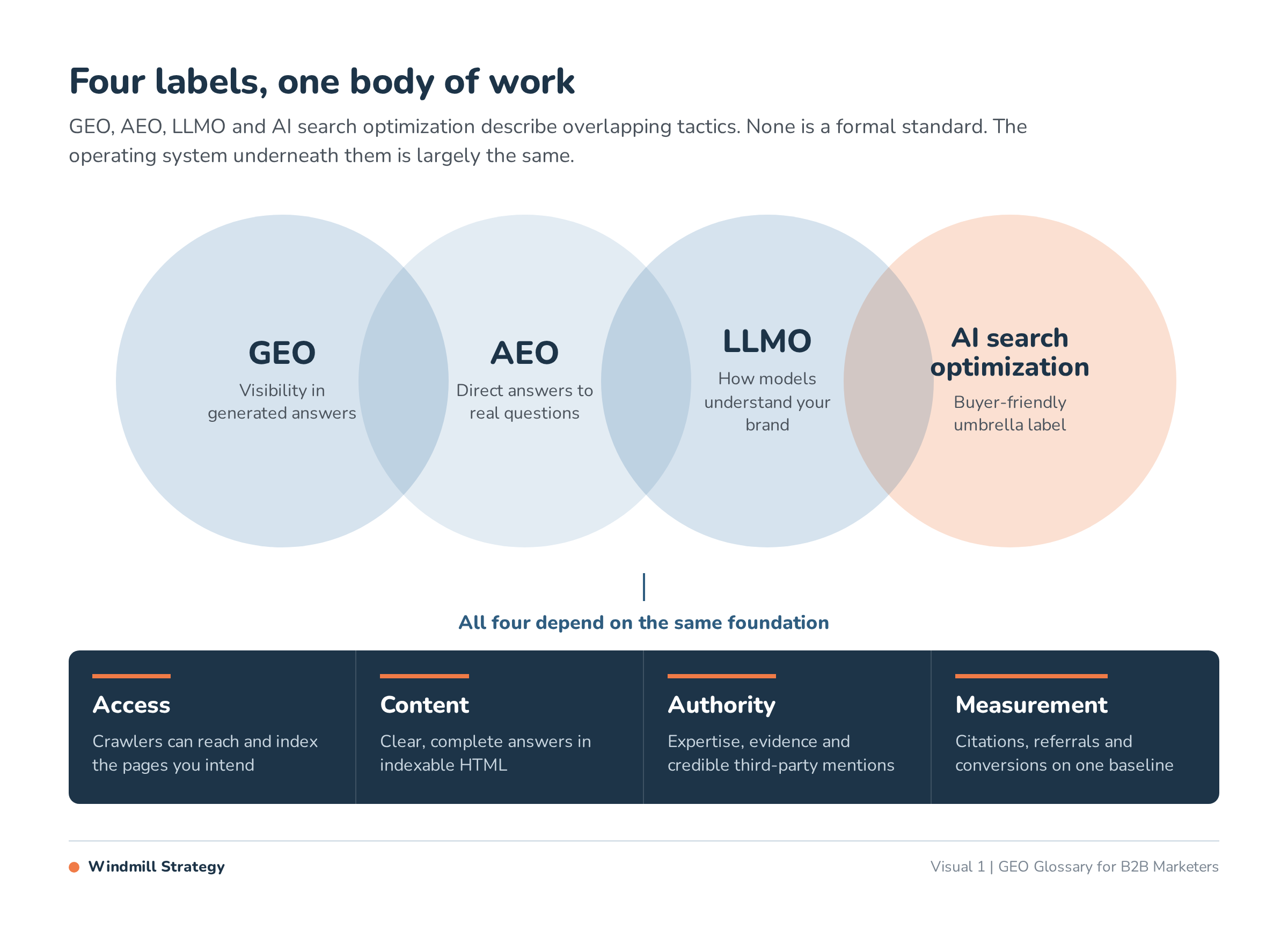
That plain definition matters because the vocabulary has outrun the evidence. GEO, AEO, LLMO and AI search optimization often describe overlapping work. Google’s current guidance is even more direct: established SEO fundamentals still apply to AI features, and there is no special AI file or schema type that guarantees inclusion.
This glossary gives B2B and industrial marketing teams a shared language, flags claims that deserve skepticism and connects each term to an action you can take.

GEO terms at a glance
| Term | Plain-English meaning | What your team should do |
| GEO | Improve visibility in generative answers | Strengthen access, content, authority and measurement |
| AEO | Make content useful for direct answers | Answer real questions clearly and completely |
| LLMO | Improve how language models understand a brand | Publish consistent facts and earn credible mentions |
| AI search optimization | Buyer-friendly label for the same body of work | Use the term your audience understands |
| AI Overviews | Google-generated summaries in search | Follow SEO fundamentals and make pages genuinely useful |
| AI Mode | Google’s conversational search experience | Support complex follow-up questions with deep content |
The core disciplines
What is generative engine optimization?
Generative engine optimization is the practice of improving a brand’s visibility in AI-generated answers and AI-assisted research. Depending on the platform and query, visibility may take the form of a linked citation, an unlinked mention, a product recommendation or an accurate description of a company’s capabilities.
The term gained traction after researchers introduced “generative engine optimization” in KDD research. The study created an early benchmark and reported visibility gains in its experimental setting; it did not reveal a current production ranking factor. The label is new; most useful practices are not. Clear information architecture, indexable HTML, original expertise, descriptive headings, strong internal links and reputable third-party mentions have long supported search performance.
For planning purposes, treat GEO as a layer in your existing program. Our guide to SEO versus GEO explains what changes and what stays the same. If you need implementation support, see our GEO consulting and industrial SEO services.
What is answer engine optimization?
Answer engine optimization (AEO) means structuring and substantiating content so a search system can use it to answer a specific question. The term predates today’s generative interfaces and was commonly associated with featured snippets, voice search and People Also Ask results.
Some practitioners draw a firm boundary between AEO and GEO. In day-to-day B2B work, the tactics overlap: identify the buyer’s actual question, answer it early, make the answer easy to verify and support it with evidence. Neither acronym is governed by an industry standard.
What is LLM optimization?
LLM optimization, or LLMO, is the effort to improve how large language model products understand and describe a company, product or topic. The phrase can cover two different pathways:
- Model knowledge: information incorporated during model development or later updates.
- Live retrieval: information found when a product searches or fetches current sources for an answer.
You cannot directly edit a model’s training data. You can publish accurate, durable facts; make current pages accessible; keep company and product descriptions consistent; and earn coverage on sources buyers trust. Our LLM optimization guide explains that broader footprint.
What is AI search optimization?
AI search optimization is a plain-language label for improving visibility across AI Overviews, AI Mode, ChatGPT search, Microsoft Copilot, Perplexity and similar experiences. It may be more useful in an executive conversation than another acronym. The work should still be tied to business outcomes, not terminology.
The surfaces where answers appear
What are Google AI Overviews?
AI Overviews are generated summaries that may appear on Google results pages. They can include supporting links that help users explore a topic. They are a search feature, not a separate marketing discipline.
Google’s feature guidance says the same technical requirements and spam policies that govern Search also apply to its AI features. Pages must be indexed and eligible to show a snippet; no special “AI schema” is required. Our AI readiness audit turns that guidance into checks for an industrial website.
What is Google AI Mode?
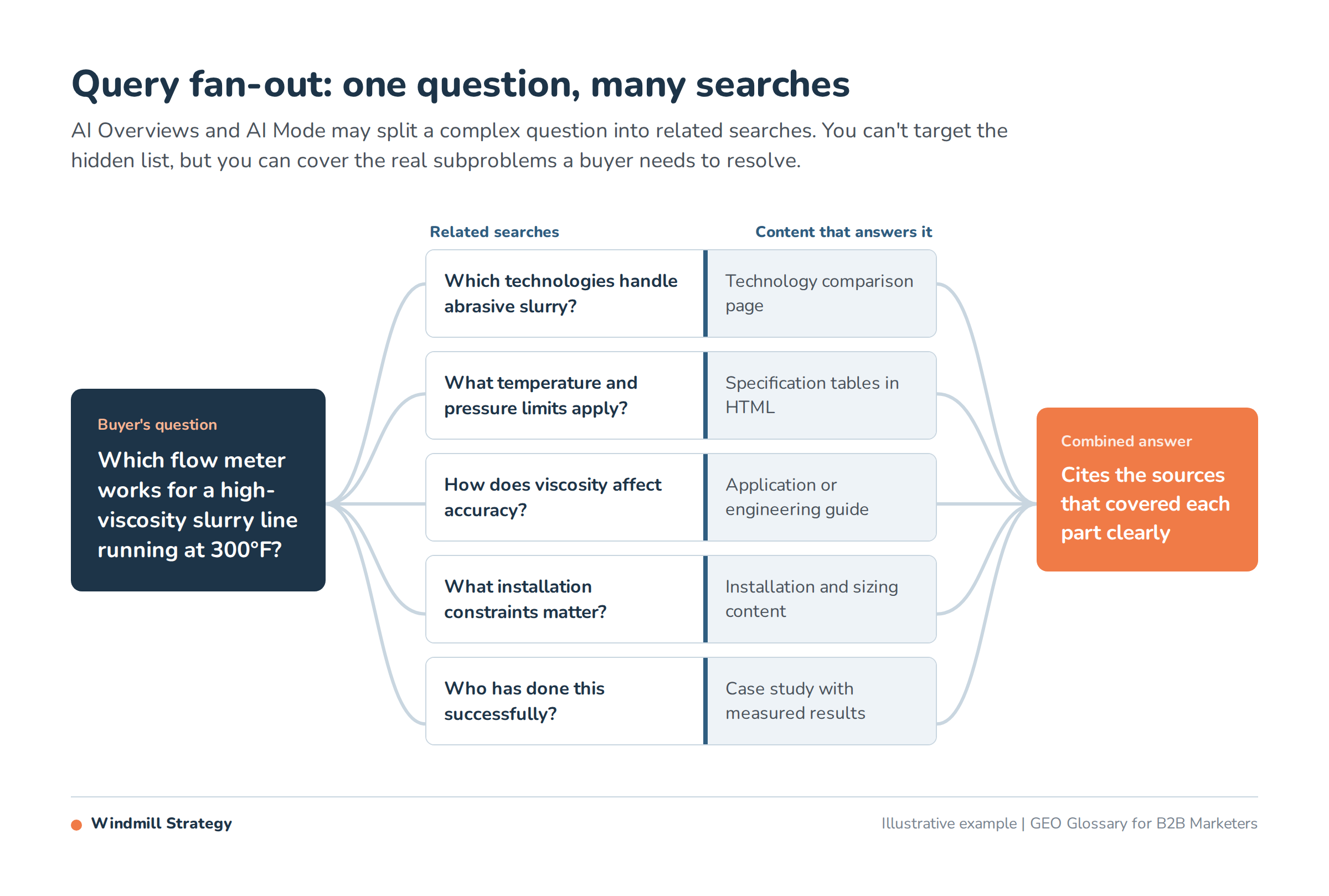
AI Mode is Google’s conversational search experience for complex questions and follow-ups. It can break a question into related searches and assemble an answer from multiple sources. For a manufacturer, that raises the value of connected content covering applications, constraints, specifications, comparisons and proof—not seven isolated posts repeating the same definition.
What is query fan-out?
Query fan-out is a retrieval technique that runs multiple related searches for different aspects of one complex question, then combines the results. Google says AI Overviews and AI Mode may use it. You cannot target a hidden list of subqueries. Build connected coverage of the real subproblems, comparisons and constraints a buyer needs to resolve.
What is an answer engine?
An answer engine is a product that responds with a synthesized answer rather than only a ranked list of links. ChatGPT, Perplexity, Copilot, Gemini and Claude can all behave this way, although their search, citation and browsing behavior differs by product, mode and date.
Do not treat one prompt in one tool as a market share study. Use a stable panel of real buyer questions, record the model and date and evaluate patterns across repeated runs.
What is zero-click search?
A zero-click search ends without a visit to another website because the results page resolves the immediate question. Definitions, calculations, weather panels and knowledge panels created zero-click behavior before generative AI. AI answers have expanded the range of queries that can be resolved on the search surface.
The implication is not “traffic no longer matters.” It is that generic impressions, qualified visits, assisted conversions, citations and self-reported attribution need to be read together. See our analysis of AI search trends.
How AI-assisted retrieval works
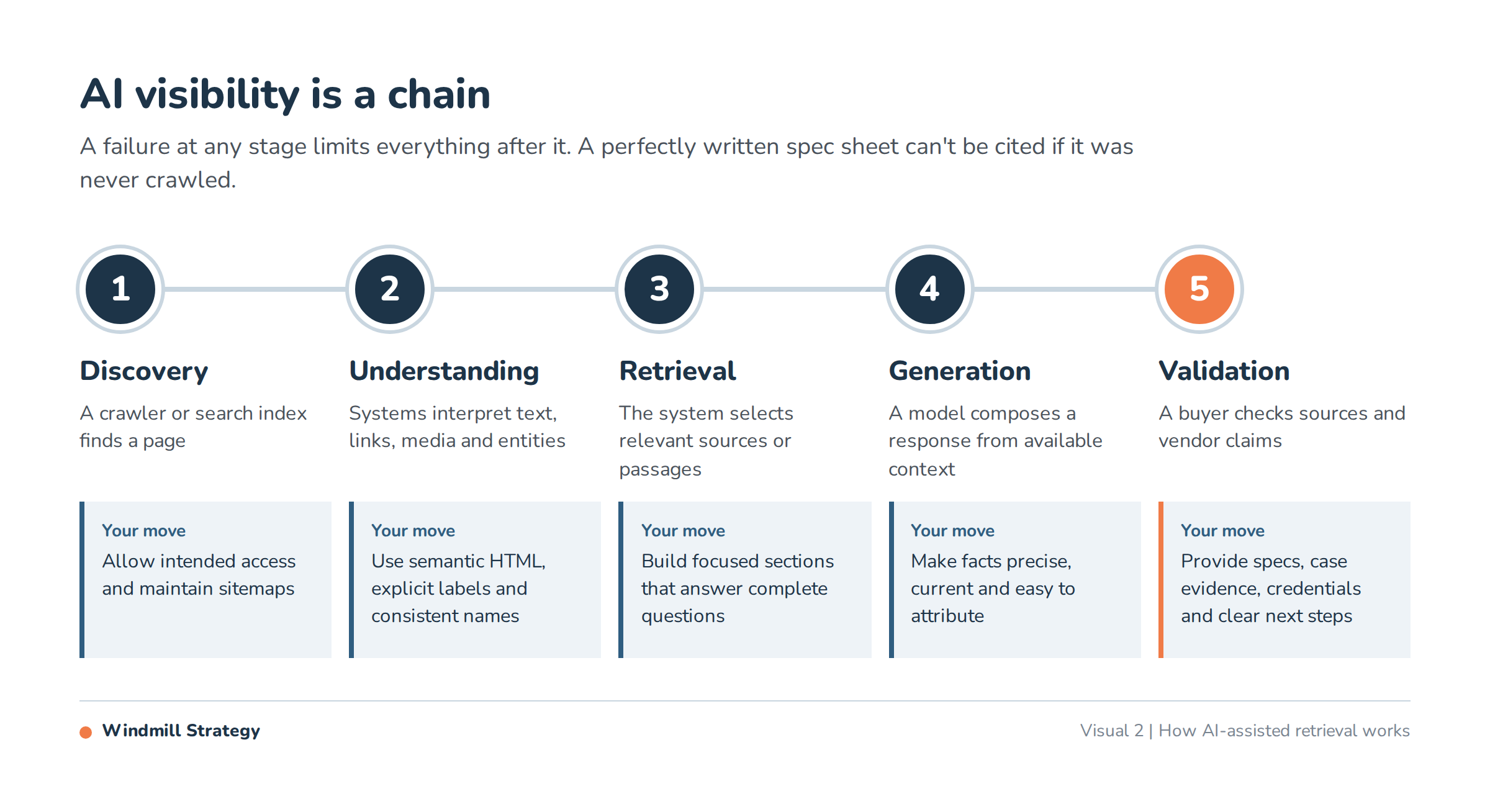
| Stage | What happens | B2B content implication |
| Discovery | A crawler or search index finds a page | Allow intended access and maintain sitemaps |
| Understanding | Systems interpret text, links, media and entities | Use semantic HTML, explicit labels and consistent names |
| Retrieval | The system selects relevant sources or passages | Build focused sections that answer complete questions |
| Generation | A model composes a response from available context | Make facts precise, current and easy to attribute |
| Validation | A buyer checks sources and vendor claims | Provide specs, case evidence, credentials and clear next steps |
What is a large language model?
A large language model (LLM) is a model trained to predict and generate language. LLMs power chat interfaces and features inside search engines, productivity tools and enterprise applications. An LLM is not automatically a search engine; a product must add retrieval, tools or browsing to use current web information.
What is retrieval-augmented generation?
Retrieval-augmented generation (RAG) combines generation with information retrieved from a search index, database or set of documents. Retrieval can make an answer more current and traceable, but a citation does not prove every generated statement is correct. B2B buyers still need clear primary evidence.
What are grounding, citations and mentions?
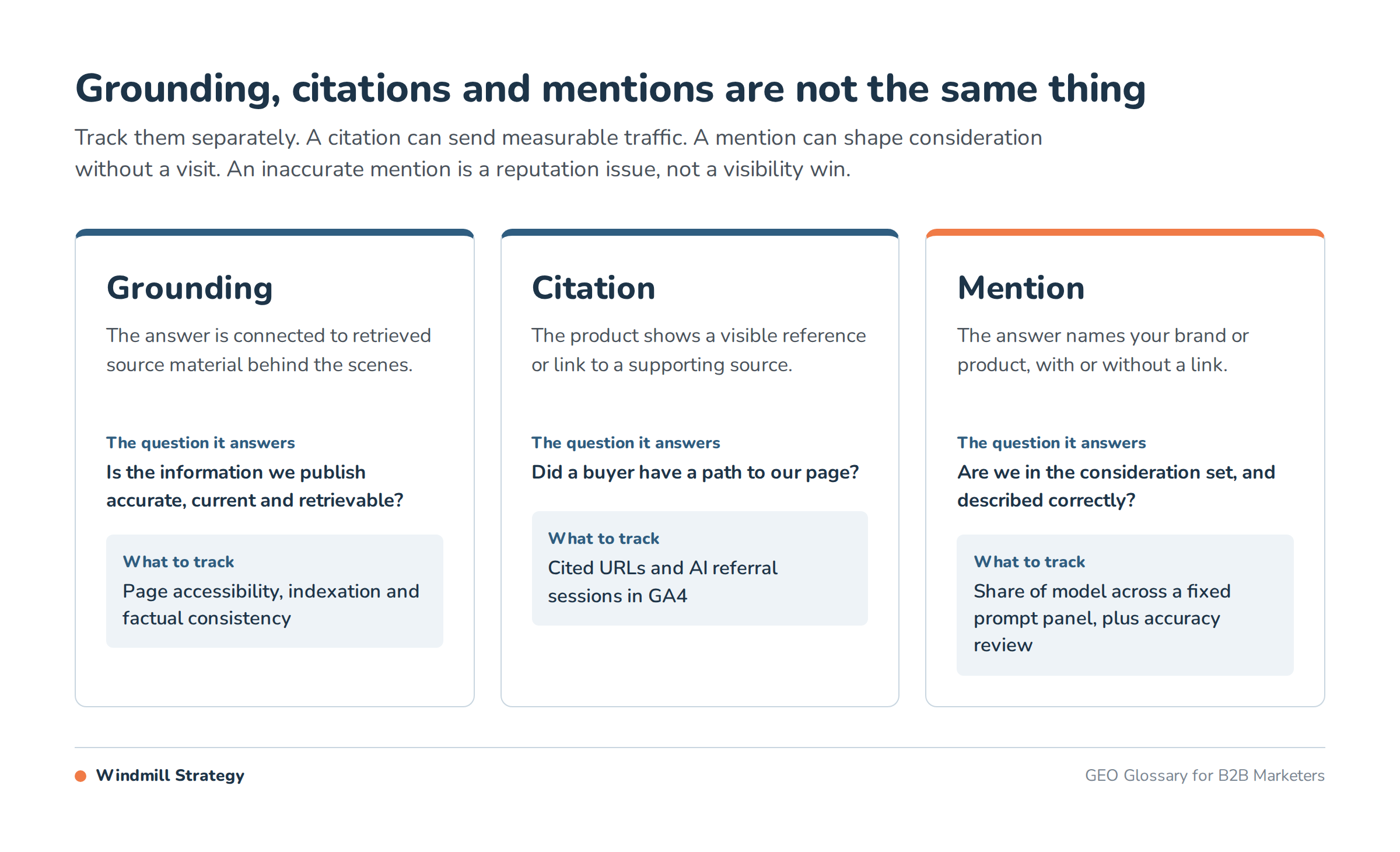
Grounding connects an answer to retrieved source material. A citation is the visible reference or link a product shows for supporting material. A mention names a brand or product without necessarily linking to it.
All three can appear in the same answer. Say your company makes stainless steel enclosures, and an engineer asks an AI assistant how to choose an enclosure for a food plant’s high-pressure washdown area:
- Grounding: The assistant retrieves your application page on washdown ratings and uses it to explain the difference between NEMA 4X and IP69K. The engineer may never know this happened, because grounding doesn’t always produce a visible link.
- Citation: The answer shows a source card or numbered footnote that links to that same page. Of the three, this is the only one that can send a click directly to your site.
- Mention: The answer lists your company among suppliers of 316 stainless enclosures, with no link. That mention could come from a distributor’s catalog, a trade publication or the model’s training data instead of your website.
Track these separately. A cited page can send measurable referral traffic. A mention can affect consideration without producing a visit. An inaccurate mention is a reputation issue, not a visibility win. If an assistant tells buyers you only make 304 stainless enclosures when 316 is your core line, you have a content and corroboration problem to fix at the source.
What is chunking?
Chunking divides a long source into smaller units for storage or retrieval. Many retrieval-augmented generation (RAG) systems use it. A RAG system answers a question by first searching a set of documents, such as a web index or a company’s knowledge base, and then passing the most relevant passages to a language model to write the response. Chunking decides how big those passages are. Chunk sizes and methods vary from system to system, and your website doesn’t control them.
The content lesson is simpler: write self-contained sections with descriptive headings, explicit subjects and enough context to make the answer clear. Don’t chop copy into artificial fragments to fit a guessed word count. The citation-ready content guide shows how to structure technical product information for people and retrieval systems.
What is an entity?
An entity is a distinct thing a system can identify, such as a company, product, person, certification or location. Consistent company names, product identifiers, expert bios, About information and structured data reduce ambiguity. They do not confer authority by themselves; corroboration and reputation still matter.
Signals, controls and standards
What is E-E-A-T?
E-E-A-T stands for experience, expertise, authoritativeness and trustworthiness. Google uses the concept in its quality-rater guidance; it is not a single ranking score or a schema field. For an industrial company, useful manifestations include named technical reviewers, real project details, test methods, revision dates, certifications, primary sources and clear ownership of claims.
What is structured data?
Structured data is machine-readable markup that describes page content with a shared vocabulary such as Schema.org. It can help search engines understand a product, organization, article or breadcrumb trail and can make pages eligible for supported search features.
It does not guarantee rankings, AI citations or rich results, and Google says there is no special structured data for AI features. Use markup that matches visible page content. The manufacturer schema guide includes a practical Product example and validation workflow.
What is llms.txt?
llms.txt is a community proposal for placing a curated, Markdown-formatted guide to a site at /llms.txt. It is not part of the robots exclusion protocol, does not grant crawl permission and is not a Google Search signal. Google explicitly says its search systems do not use it.
An llms.txt file may be a low-cost experiment for agents that choose to read it, but it should come after robots policies, server access, indexability and useful HTML content. The crawler access guide separates llms.txt, crawler user agents, robots.txt and firewall enforcement.
What is share of model?
Share of model is the percentage of a defined prompt set in which a brand is mentioned or cited, usually compared with named competitors. It can be useful as a directional visibility metric when the prompt panel, platform, geography, model and collection date are documented.
It is not a census of everything buyers see. Answers vary, prompts are sampled and platforms change. Pair it with outcomes using our guide to AI traffic measurement.
What actually matters for B2B visibility
The durable operating model has five parts:
- Access. Search and AI crawlers can fetch the pages you intend them to use.
- Clarity. Important answers and specifications are visible in HTML and unambiguous.
- Evidence. Named experts, methods, examples, data and case studies support the claims.
- Corroboration. Reputable third-party sources describe the company consistently.
- Measurement. Search visibility, citations, referrals, conversions and self-reported sources share a baseline.
This is also how technical buyers increasingly research: they frame a problem in conversation, form a shortlist, validate vendors on the web and approach sales later. Read the engineer research journey for the commercial implications. Then use the thin-content strategy to decide what to consolidate, deepen or retire.
Windmill’s client work shows why the system matters more than a tactic. Following coordinated improvements to focused content, structured data and measurement, our client Panel Built appeared in nearly 600 AI Overviews and saw ChatGPT referrals rise 61% year over year; see the Panel Built case study for further details. Mott Corp’s program started by addressing low-hanging fruit such as an erroneous noindex, thin content, weak headings and internal links; it later appeared in more than 300 AI Overviews while organic form submissions rose 63.6%. See the Mott SEO case study.
Those results should not be credited to a single markup field or acronym. They followed connected technical, content and measurement work.

Build the next-quarter plan
- Run the AI visibility audit.
- Fix access and indexability findings first.
- Move essential product facts from image-only or gated assets into useful HTML.
- Connect related pages with descriptive internal links.
- Add visible authorship, review dates and first-hand evidence.
- Establish AI reporting in GA4, Search Console and Bing Webmaster Tools.
- Review a fixed prompt set quarterly, not an anecdotal prompt weekly.
If your team needs a prioritized roadmap across content, SEO, analytics and development, Windmill’s Digital Marketing Quick Start and industrial marketing expertise are useful starting points.
Frequently asked questions
Is GEO different from SEO?
GEO emphasizes visibility in generated answers, citations and brand mentions. SEO covers the broader work of earning visibility and useful traffic from search. In practice, GEO depends heavily on SEO fundamentals and adds attention to retrieval, citation monitoring and off-site corroboration.
Does schema improve AI citations?
Schema can reduce ambiguity and support eligible search features, but it does not guarantee an AI citation. Mark up accurate information that users can also see, validate it and measure the result alongside content quality and authority.
Do we need llms.txt?
No. Google Search ignores it, and it does not replace robots.txt or server access controls. Consider it an optional experiment only after higher-impact fundamentals are working.
How do we measure GEO?
Use a balanced scorecard. Start with the platform data: the Search Console AI report and Bing AI Performance show how your pages perform in each search engine’s AI features. They only cover their own platforms, though. To track how AI assistants cite and mention your brand over time, use an AI visibility tool such as Aerovane, Windmill’s AI visibility tracking platform. Then tie visibility to outcomes with AI Assistant referrals in GA4, conversions and pipeline, and self-reported attribution. No single metric captures the whole journey.
Which GEO term should our team use?
Choose one umbrella term and define it. Windmill uses generative engine optimization because it covers generated answers broadly, but “AI search visibility” can be clearer for non-specialists. Consistency is more important than winning the naming debate.