

How AI Overviews, Zero-Click Search, and GEO Are Reshaping B2B SEO
For more than two decades, SEO ran on a simple exchange: create content, earn a ranking, get the click, and turn that traffic into leads. That model worked for a long time. It’s now changing faster than most marketing teams can keep up with.
Search engines no longer just point people to answers; they generate the answers directly. AI-generated summaries, featured snippets, and conversational tools now resolve a question right on the results page. For B2B and industrial companies, this matters more than it might first appear. Your buyers are engineers, plant managers, and technical decision-makers who research thoroughly before they ever contact sales. Increasingly, that research happens inside AI tools, not on your website.
This article covers what’s actually happening, what the data shows, and how to adapt without abandoning the SEO fundamentals that still work.
- What AI Overviews and Zero-Click Search Mean For You
- Why Volume-Based SEO Is Losing Steam
- Enter GEO: Generative Engine Optimization
- From Keywords to Authority
- Why B2B and Industrial Companies Have An Edge
- The New Goal: Influence and Qualified Leads, Not Just Traffic
- How to Adapt Your Strategy for AI Search
- SEO Isn’t Dying, It’s Evolving
- Ready to Make Your Content the Source AI Trusts?
What AI Overviews and Zero-Click Search Mean For You
An AI Overview is the AI-generated summary that appears at the top of a Google search, pulling information from multiple sources to answer a query before any traditional listing. A zero-click search is any search that ends without the user clicking through to a website, because the answer was already there, in the summary.
Neither idea is brand new. Featured snippets, knowledge panels, and local packs have absorbed clicks for years. What’s new is the scale. According to SparkToro’s 2024 zero-click study, only about 360 of every 1,000 U.S. Google searches result in a click to the open web. The rest end on Google or go nowhere at all.
AI Overviews are accelerating this. Semrush’s analysis of more than 10 million keywords found AI Overviews triggering on roughly 20 percent of Google searches by mid-2025, and increasingly for commercial and navigational queries, not just informational ones. The impact on clicks is measurable. A Pew Research Center study of nearly 69,000 real searches found that when an AI summary appeared, users clicked a traditional result just 8 percent of the time, compared to 15 percent without one, roughly half. Only 1 percent clicked a link inside the summary itself, and people were noticeably more likely to end their session entirely.
Keyword-tracking data points the same direction. Ahrefs reported that the presence of an AI Overview correlated with a 58 percent lower click-through rate for the top-ranking page by late 2025, up from an earlier estimate of 34.5 percent. Agency Seer Interactive found that organic click-through rates on informational queries fell 61 percent, with paid down 68 percent, and even queries without an AI Overview saw clicks decline. People are simply clicking less, everywhere.
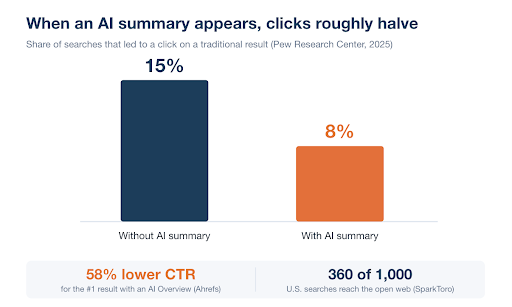
For your marketing program, the takeaway is this: you can hold your rankings, watch impressions hold steady or even grow, and still see traffic erode. Visibility and traffic are no longer the same thing.
Why Volume-Based SEO Is Losing Steam
For years, traditional SEO rewarded volume. More blog posts, more keywords, more indexed pages, more impressions. That playbook delivered results.
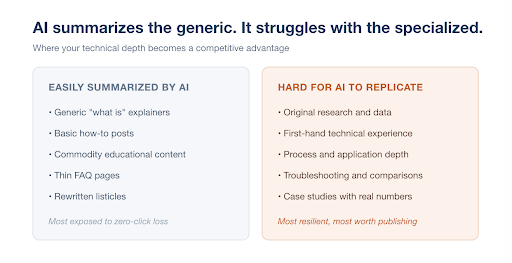
The problem is that AI systems are exceptionally good at summarizing generic content. If a page restates information that already exists in a dozen other places, an AI engine can synthesize the key points instantly, with no click required. The content most exposed to this includes basic “what is” explainers, thin how-to posts, commodity educational content, and rewritten listicles.
In many B2B and industrial niches, the old “publish more” strategy is quietly losing its return. The pages most vulnerable to AI summarization are often the ones that were easiest to produce in the first place. This isn’t a bad thing, because ultimately, the engineers that most B2B industrial marketers want to bring to their site wouldn’t be that interested in reading yet another “what is industrial air filtration” article in the first place. This type of content cluttered many websites in support of better SEO, without adding real value to users.
Enter GEO: Generative Engine Optimization
This is where Generative Engine Optimization comes in. GEO is the practice of optimizing your content and brand so that AI-generated search experiences retrieve, trust, and cite you.
The discipline isn’t marketing hype; it has academic roots. Researchers from Princeton, Georgia Tech, the Allen Institute for AI, and IIT Delhi formalized GEO in a peer-reviewed paper presented at the ACM KDD 2024 conference. Testing content strategies across thousands of queries, they found that GEO methods could boost a source’s visibility in generative responses by up to 40 percent. Notably, the tactics that worked were not the old SEO game-the-system tricks. Keyword stuffing, as an example, performed poorly. Instead, methods that worked included adding relevant statistics, citing credible sources, and including quotations from authorities.
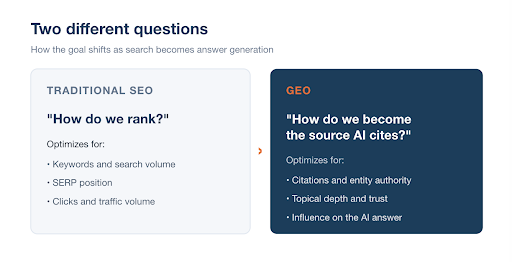
Traditional SEO asks, “How do we rank?” GEO asks a different question: “How do we become a source the AI references?” In an AI-driven results page, your content, data, or brand can shape the answer a buyer receives even when they never click your link. The goal shifts from winning clicks to becoming the source AI systems trust. We cover the tactical side of this in our guide to LLM optimization for industrial B2B companies.
From Keywords to Authority
Historically, SEO leaned heavily on keyword matching: exact phrases, search volume, and ranking positions. Those signals still matter. But AI systems increasingly weigh expertise, context, the relationships between topics, and how consistently a brand shows up as an authority across the web.
That favors companies with genuine depth over those producing large volumes of shallow content. The content most resilient to AI disruption tends to share a few traits: it’s based on original research, first-hand experience, and technical expertise; it includes case studies and real numbers; and it explains processes in detail rather than skimming the surface. AI can summarize information. It struggles to replicate experience.
This is good news if your expertise is real. It’s a warning if your content strategy has been built on hitting a word count.
Why B2B and Industrial Companies Have An Edge
Some of the biggest opportunities in this shift sit squarely in manufacturing, engineering, and technical B2B markets.
These industries involve complex workflows, specialized terminology, high-consideration purchases, and application-specific knowledge. AI systems still handle fragmented, highly technical, context-heavy information poorly. That gap creates room for companies willing to publish the kind of content AI can’t easily fabricate: technical explainers, troubleshooting resources, comparison guides, maintenance workflows, application-specific content, and industry case studies.
In many industrial sectors, true expertise online is still scarce. While consumer and broad B2B niches are saturated, the specialized corners where your customers actually search often aren’t. As generative search expands, that authoritative niche content becomes more valuable, not less.
The New Goal: Influence and Qualified Leads, Not Just Traffic
One of the hardest mindset shifts in modern SEO is accepting that raw traffic is no longer the only metric that matters. A company can influence a buying decision through an AI summary, a citation, or a brand mention long before, or instead of, an immediate click.
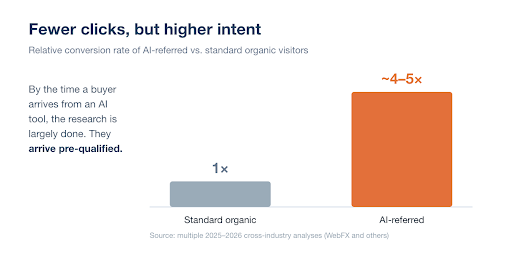
The data suggests this influence is worth chasing. Across multiple 2025 and 2026 analyses, AI-referred visitors converted at roughly four to five times the rate of standard organic visitors. The reason is straightforward: by the time someone clicks through from an AI tool, the research and comparison phase is largely done. The AI has effectively pre-qualified them.
This matters especially for technical industries. Manufacturing, professional services, and software together accounted for a meaningful share of generative-AI referral traffic in 2025, as technical buyers folded AI tools into their procurement research. Tools like Perplexity skew toward exactly the kind of researchers and engineers who influence your deals. For a company that has always cared more about lead quality than lead volume, this is a familiar and welcome trade.
In other words, fewer clicks of higher quality may serve your sales team better than the broad, unqualified traffic that volume-based SEO often delivered. That same principle is foundational to our approach to B2B digital marketing: better traffic over more traffic, and increasing lead quality and quantity.
How to Adapt Your Strategy for AI Search
Adapting doesn’t mean tearing up your SEO program. It means evolving it. Five priorities stand out.
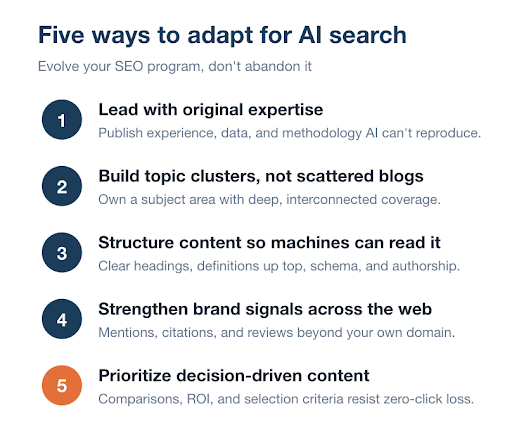
Lead with original expertise. AI can summarize public information. It can’t easily reproduce your real-world experience, customer insights, internal data, or proprietary methodology. The more original your content, the harder it is to commoditize. Put your engineers’ and subject-matter experts’ knowledge on the page.
Build topic clusters, not scattered blogs. Publishing disconnected posts for isolated keywords is fading in effectiveness. Instead, own a subject area: build interconnected resources that demonstrate consistent, deep coverage of the topics your buyers care about. AI systems and search engines increasingly reward topical authority over sheer volume.
Structure content so machines can read it. AI systems favor content that is clearly organized and easy to parse. Use a clear heading hierarchy, put definitions near the top, add tables and well-structured lists where they help, include schema markup, and attribute authorship. Clean structure improves both human readability and machine comprehension.
Strengthen your brand signals across the web. AI systems don’t evaluate your site in isolation. They assess mentions, citations, reviews, and references across industry publications, directories, and social discussions. A brand that shows up consistently as an authority is more likely to be treated as a trusted entity, so invest in the visibility that happens beyond your own domain.
Prioritize commercial and decision-driven content. Pure informational content is the most exposed to zero-click behavior. Content tied to a buying decision is more resilient. Focus on product and solution comparisons, ROI discussions, vendor selection criteria, integration considerations, and implementation guidance. These queries demand the kind of depth AI can’t fully satisfy in a short summary.
SEO Isn’t Dying, It’s Evolving
It’s worth keeping perspective. The claim that “SEO is dead” misses what’s actually happening. Search visibility still matters enormously; what’s changing is how users discover information, where answers appear, and what earns trust. The fundamentals of industrial SEO, such as clear site structure, technical health, and content built around the queries your best prospects make, remain the foundation that GEO builds on.
Industry forecasts capture the scale of the shift. Gartner predicted that traditional search engine volume would fall 25 percent by 2026 as AI chatbots and virtual agents absorb queries that once went to search. That figure is debated. Some analysts argue the cost and accuracy limits of AI tools will slow the change, but the direction of travel is hard to dispute.
The old equation was: more pages equal more rankings equal more traffic. The emerging one looks more like: more expertise equals more trust equals more citations equals more influence. Companies that adapt early will hold a meaningful advantage over competitors still chasing content volume.
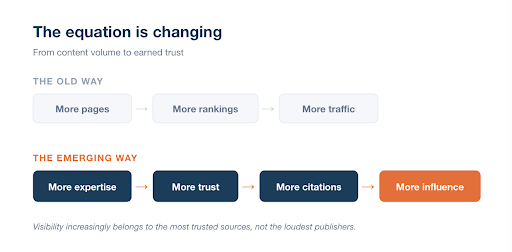
In an AI-first search landscape, visibility increasingly belongs not to the loudest publishers, but to the most trusted sources. For B2B and industrial companies with genuine technical depth, that’s a game you’re well positioned to win.
Ready to Make Your Content the Source AI Trusts?
You don’t have to overhaul your entire marketing program, or wait months for an audit, to start adapting. A Digital Marketing Strategy Quick Start from Windmill Strategy gives you access to senior strategists who know B2B and industrial marketing, plus a prioritized, three-month roadmap focused on your highest-impact opportunities. We’ll help you pinpoint where your content is most exposed to AI summarization, where your authority can grow, and what to fix first to win qualified leads in an AI-driven search world.
Learn more about the Quick Start, or reach out and let’s talk.