

Why Thin Top-of-Funnel Content Was Already Dead (and AI Just Buried It)

Thin top-of-funnel content fails because it does not help a defined buyer understand a problem, make a decision or verify a claim. AI search did not invent that weakness. It raised the opportunity cost of publishing interchangeable explanations that a search results page, competitor or AI assistant can summarize without losing anything important.
The headline is intentionally blunt, but the distinction matters: top-of-funnel content is not dead, and short content is not automatically thin. A concise definition written by a credible expert can be excellent. A 2,500-word article can still be thin if it merely expands a familiar consensus. The issue is utility and originality, not funnel stage or word count.
Key takeaways
- Thin content lacks meaningful buyer utility, original knowledge or credible evidence.
- Useful awareness content still earns attention by clarifying real industrial problems.
- AI-assisted search increases the value of non-commodity expertise; it does not eliminate websites.
- Content pruning should follow evidence and intent, not a blanket deletion rule.
- Improve, consolidate or retire each page according to demand and unique value.
- Key takeaways
- What “thin” means in an industrial content library
- AI search raises the standard
- The business cost of keeping weak pages
- Use this content action matrix
- Audit quantitative and qualitative evidence
- Choose the right action
- Build the replacement portfolio
- Put a quality gate in every brief
- Prune without chasing freshness
- Frequently asked questions
- Publish what only your team can know
What “thin” means in an industrial content library
Top-of-funnel content serves people who are defining a problem, learning terminology or exploring approaches. It can include explainers, glossaries, application overviews, troubleshooting articles and introductory guides. Those are legitimate jobs.
Thin content is content that performs one of those jobs poorly. Common forms include:
- A definition that restates the first paragraph of every competing page
- A “benefits of” article with no conditions, trade-offs or evidence
- A trend list that contains no observation from the company’s actual work
- Multiple pages targeting slight keyword variations with substantially the same answer
- An outdated article that conflicts with current product or sales information
- A long post padded to reach an assumed SEO word count
Google’s people-first content guidance asks whether a page contains original information or analysis, demonstrates first-hand expertise and leaves readers feeling they have learned enough to achieve their goal. It also says Google has no preferred word count. That is a more useful test than page length.
Note – as you read this article, refer to our GEO glossary for definitions of GEO, AEO, AI Overviews and related terms as needed.
AI search raises the standard
An AI assistant is effective at synthesizing widely repeated information. If an article’s entire contribution is a generic explanation, the user may be able to get the core answer without visiting it. Google now advises publishers to create valuable, non-commodity content and warns against producing many pages for query variations primarily to manipulate rankings. See Google’s AI-search guidance.
That does not mean every informational query is now zero-click. Current evidence is more nuanced. In 2026 technical-buyer research, 75% of surveyed engineers and technical buyers said they had noticed AI-generated search summaries. Of those, 69% read the summary and continued into the results; only 6% said the summary was usually sufficient. Traditional search also remained the most-used research route.
The practical lesson is not “stop publishing awareness content.” It is “make the click worth earning.” If a technical buyer continues from a summary to your page, the page should add application context, proof, a decision framework or an expert point of view that the summary could not fully supply. Our AI Overviews analysis explores that changing search environment.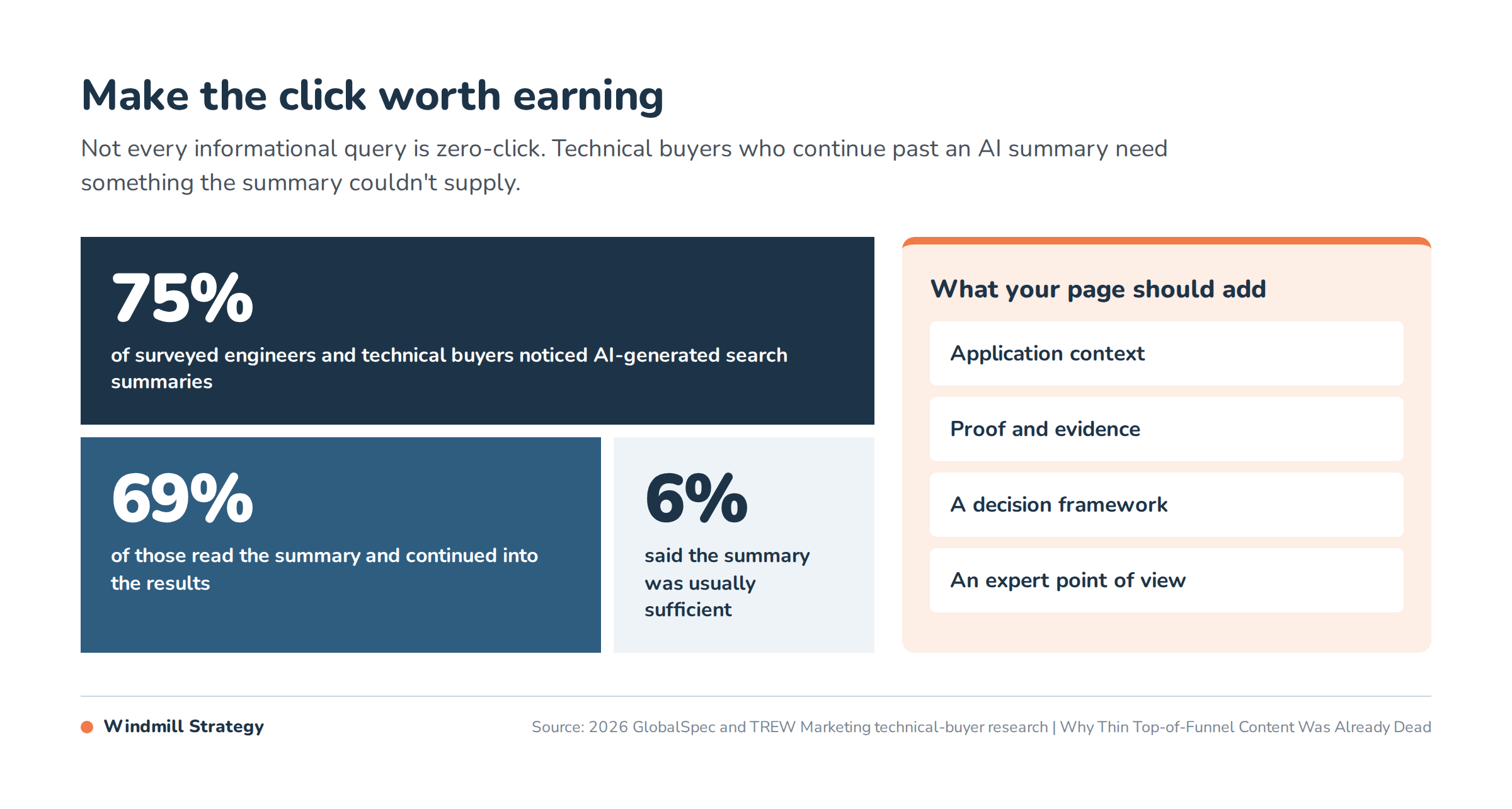
The business cost of keeping weak pages
A weak content archive is not automatically a site-wide penalty, and most industrial websites do not need to obsess over crawl budget. The more immediate risks are operational and commercial.
It spends expert time poorly
Every page requires briefing, review, publishing and maintenance. Time spent refreshing a generic listicle is time not spent documenting a test, interviewing an engineer or improving a high-value product page.
It creates conflicting answers
Old articles often preserve discontinued terminology, obsolete capabilities or claims that no longer match sales guidance. Buyers—and systems that retrieve those pages—may encounter the wrong version.
It weakens the validation experience
A buyer who arrives with a serious technical question quickly notices whether the page contains conditions, units, methods and accountable expertise. Generic copy can make a capable company look less knowledgeable than it is.
It obscures the best answer
Several overlapping posts can compete for internal links, confuse content owners and force readers to assemble one answer from multiple partial pages. Consolidation can create a clearer canonical resource.
Use this content action matrix
Evaluate each URL on two axes: demonstrated demand and unique buyer utility.
| High unique utility | Low unique utility | |
| High demonstrated demand | Keep and expand. Protect the URL, update evidence and strengthen conversion paths. | Rebuild or consolidate. Demand exists, but the current page does not deserve it. |
| Low demonstrated demand | Reposition and distribute. The expertise may need a better title, format, audience or internal path. | Retire thoughtfully. Preserve any useful equity and remove unsupported clutter. |
This matrix prevents two common mistakes: keeping a page because it once received traffic, and deleting a page because last-click conversions are low. A technical reference may support sales conversations or attract valuable links even when it rarely produces a direct RFQ.
Audit quantitative and qualitative evidence
Start with an inventory of indexable content URLs. For each page, collect what is available:
- Organic impressions, clicks and landing-page trends
- Identifiable AI referrals
- Backlinks and referring domains
- Key events and assisted conversions
- Internal links and content depth
- Publication and substantive-review dates
- Sales, support or training use
Then add editorial judgment. A spreadsheet cannot tell you whether a process engineer would trust an explanation. Score five dimensions:
| Dimension | Audit question | Evidence to record |
| Audience | Is a specific reader and task clear? | Intended role, stage and question |
| Contribution | What can this source add uniquely? | Experience, data, framework or example |
| Completeness | Can the reader act or decide? | Conditions, trade-offs and next steps |
| Trust | Can important claims be verified? | Author, reviewer, sources, methods and dates |
| Strategic fit | Does the page support an offering or authority area? | Related service, product and internal path |
Use the broader content readiness audit when technical access, indexability, structured data and measurement also need review.
Choose the right action
Keep and strengthen
Protect pages that satisfy a real audience, earn relevant demand or contain difficult-to-recreate expertise. Update facts and examples, improve the opening answer, add visible authorship and make the next step clearer. Do not change a date unless the content was substantively reviewed.
Rebuild
Rebuild a promising page when the query or buyer need is valid but the article is generic. Interview a subject-matter expert. Add decision criteria, constraints, examples and cited evidence. A basic “what is” page can become a useful application guide without abandoning its introductory purpose.
Consolidate
Merge pages that answer substantially the same intent. Select the strongest URL using relevance, links, history and usability—not title preference alone. Combine the genuinely useful material, update internal links and use a permanent server-side redirect from each retired URL. Google’s permanent redirect guidance explains how redirects signal the preferred destination.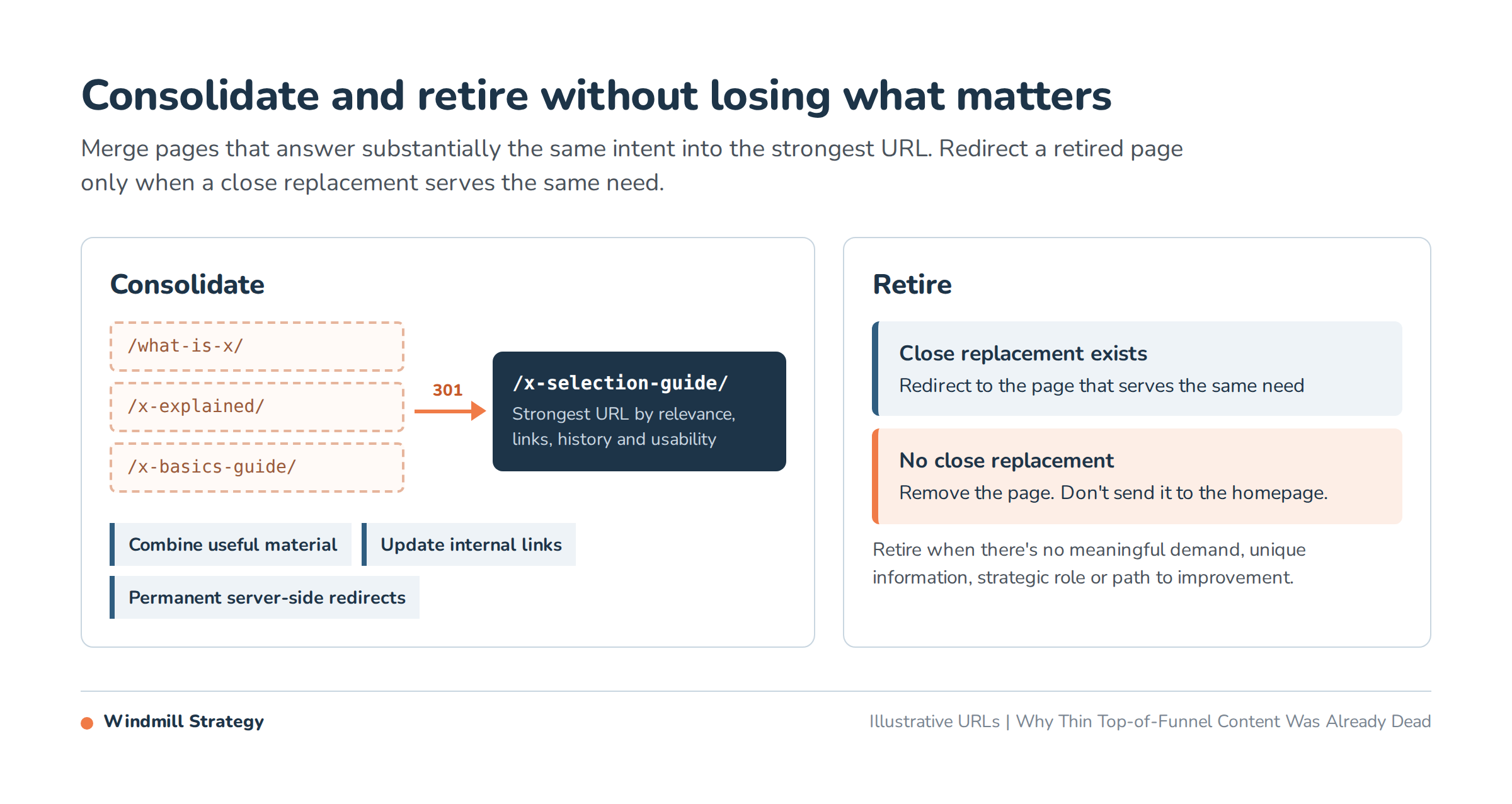
Retire
Remove a page when it has no meaningful demand, unique information, strategic role or suitable path to improvement. Redirect only when a close replacement serves the same need. Sending every removed article to the homepage creates a poor experience and hides what actually changed.
Build the replacement portfolio
The replacement for thin volume is not simply “longer content.” It is a smaller number of assets with clearer jobs.
Problem and failure-mode guides
Explain symptoms, possible causes, diagnostic steps and boundaries. These pages support early research without pretending every problem leads directly to your product.
Selection and comparison guides
Show how operating conditions change the decision. Include when an alternative is a better fit. Candor gives the reader useful criteria and gives your expertise a recognizable point of view.
Technical product and capability pages
Publish specifications, tolerances, materials, compatibility, standards, operating limits and update ownership in accessible HTML. Our guide to citable product content provides a practical structure.
Original evidence
Use test results, anonymized project patterns, benchmarks, calculators and documented lessons when the business can substantiate them. State the sample, method, date and limitations. “Proprietary” does not excuse weak methodology.
Case studies and expert analysis
Show the situation, constraints, work and measured outcome. Windmill’s Mott case study demonstrates how an audit surfaced technical and content issues and informed ongoing SEO improvements; organic form submissions subsequently increased 63.6%. The result belongs to a coordinated program, not one content edit.
This portfolio also aligns with the engineer research journey: problem framing, approach comparison, supplier discovery, technical validation and sales engagement each require different evidence.
Put a quality gate in every brief
Before commissioning a new page, require clear answers to these questions:
- Who is this for, and what are they trying to accomplish?
- Which subject-matter expert will provide or review the substance?
- Which claims require a primary source, method or qualification?
- Where does this page sit in the internal-link path?
- What buyer action or learning outcome will indicate usefulness?
- Who owns the next substantive review?
If the brief cannot answer the first three, it is not ready. AI can help organize notes or test clarity, but it cannot manufacture first-hand experience that the company never supplied. Windmill’s content strategy services combine search research with interviews and technical review to build that substance.
Prune without chasing freshness
Google explicitly says that adding or removing many pages simply to make a site seem fresh does not improve rankings. Pruning should improve the user experience and content system.
Use this sequence:
- Export and crawl the full inventory.
- Group URLs by audience, task and search intent.
- Add performance, link and conversion evidence.
- Review pages with sales and subject-matter experts.
- Assign keep, rebuild, consolidate or retire.
- Map redirects and update internal links before removal.
- Update sitemaps, canonicals and reporting annotations.
- Monitor affected topics and conversions after launch.
Keep a decision log. It makes later traffic changes easier to interpret and prevents a future editor from recreating a page that was deliberately consolidated.
Frequently asked questions
Is short content thin content?
No. A short page can completely answer a narrow question. Thinness is a lack of useful substance, not a word count.
Is top-of-funnel content still worthwhile?
Yes, when it helps a relevant audience frame a problem or compare approaches. Generic awareness volume is the problem, not the awareness stage.
Should we delete every page without traffic?
No. Check backlinks, sales use, strategic relevance, seasonal demand and whether the page needs better positioning. Traffic is one signal.
Does deleting old content improve SEO?
Not by itself. Delete, merge or improve a page because the resulting experience and information architecture are better—not to make the site appear fresh.
What should replace generic articles?
Prioritize problem guides, selection criteria, technical pages, original evidence, case studies and accountable expert analysis. The right mix depends on actual buyer questions and business priorities.
Publish what only your team can know
AI search did not make expertise obsolete. It made interchangeable summaries easier to recognize. A strong B2B content strategy captures what engineers, technicians, sales teams and customers know, then turns it into information another company could not honestly publish.
If your library needs a defensible audit and a sharper editorial plan, talk with Windmill.