

The Engineer’s New Research Journey: From Google to ChatGPT to Your Sales Team
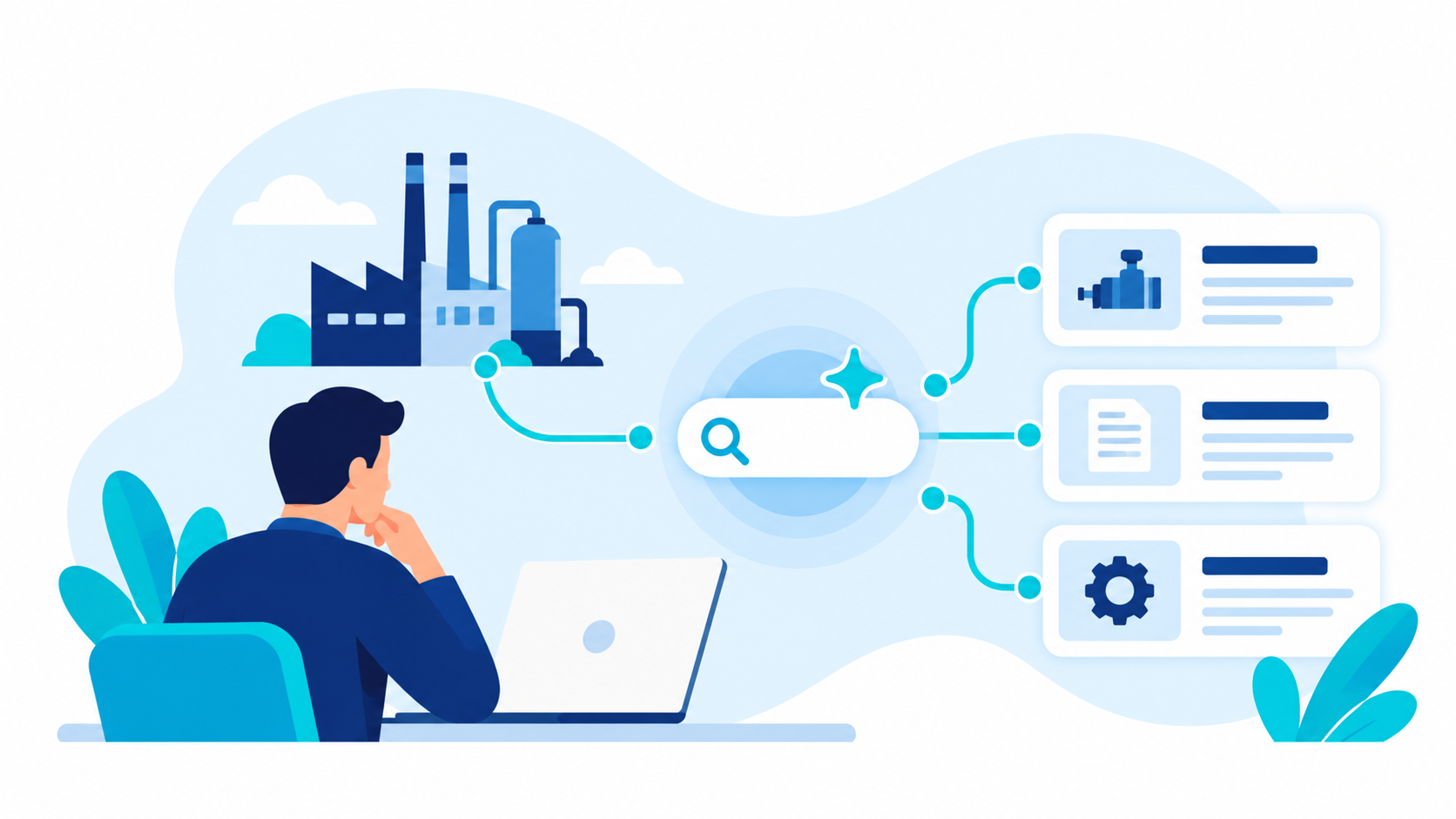
AI is changing the B2B buying process for engineers, but not by replacing Google, vendor websites, colleagues or salespeople. It is adding a conversational research layer. An engineer can use an AI assistant to frame a problem, generate alternatives or summarize unfamiliar terminology, then turn to search results and primary sources to verify what matters.
That distinction is important. The emerging journey is not “ChatGPT instead of Google,” and it is not a universal sequence. It is a hybrid, iterative process whose exact shape depends on the buyer, risk, product category and company. Industrial marketers should treat the stages below as an evidence-informed model to test against their own customers—not as a claim about every engineer.

Key takeaways
- AI can accelerate problem framing and comparison, while traditional search remains central.
- Technical buyers still verify claims through specifications, experts, case studies and direct conversations.
- A vendor website must support both discovery and rigorous validation.
- Sales creates the most value by adding application context, not repeating generic website copy.
- Analytics reveals only part of the journey, so customer interviews and self-reported attribution matter.
- Key takeaways
- What current buyer research shows
- A working map of the new research journey
- Stage 1: Frame the problem
- Stage 2: Explore approaches and trade-offs
- Stage 3: Discover possible suppliers
- Stage 4: Validate technical fit
- Stage 5: Align the buying group
- Stage 6: Bring sales in for context
- Different roles need different proof
- What marketing and sales should change
- Measure the journey without pretending it is fully observable
- Frequently asked questions
- Build for the next question
What current buyer research shows
The strongest evidence points to addition, not wholesale replacement. GlobalSpec and TREW Marketing’s 2026 engineering-buyer research surveyed more than 1,000 engineers and technical buyers. It found that 69% use generative AI at least occasionally during a work-related purchasing decision. Yet 77% said they use traditional search engines more often, while 8% favored generative AI and 16% used them equally.
Verification remains part of the pattern. Among respondents who noticed AI-generated search summaries, 69% read the summary and continued into the search results; only 6% said the summary was usually sufficient. The same study reported that 62% of the technical buying process happens online before vendor contact.
Those figures do not prove that a specific engineer will use a specific tool at a specific stage. They do support a practical hypothesis: AI may influence early understanding and consideration, while searchable source material, vendor evidence and human expertise remain critical. The terms behind this ecosystem are defined in our AI search glossary.
A working map of the new research journey
| Stage | Engineer’s task | Likely research surfaces | What earns the next step |
| 1. Frame | Define the failure, requirement or opportunity | Colleagues, AI assistants, search, internal documents | Clear problem explanations and terminology |
| 2. Explore | Compare solution classes and trade-offs | Search results, AI answers, publications, forums | Honest selection criteria and limitations |
| 3. Discover | Identify plausible suppliers | Search, directories, referrals, AI-generated lists | Specific capabilities and consistent company facts |
| 4. Validate | Confirm technical and operational fit | Product pages, datasheets, case studies, videos | Specs, standards, proof and accessible experts |
| 5. Align | Resolve risk across the buying group | Shared documents, vendor content, procurement tools | Consistent answers for engineering, quality and purchasing |
| 6. Engage | Ask application-specific questions or request a quote | Sales engineer, distributor or representative | Contextual guidance and a low-friction handoff |
Stage 1: Frame the problem
Industrial research often starts with a symptom or constraint rather than a named product: premature seal failure, an unexpected pressure drop, a tolerance that cannot be held or a material that will not survive the environment. A conversational interface can be useful here because the user can add conditions and ask follow-up questions without translating the problem into a perfect keyword.
For marketers, the opportunity is problem-first content. Application notes, troubleshooting guides, terminology pages and failure analyses can establish the concepts that later connect to a solution. These pages should state assumptions and boundaries. An AI-generated answer can be confidently wrong; a careful source explains when its guidance does and does not apply.
Stage 2: Explore approaches and trade-offs
Once the problem is defined, a buyer may compare materials, processes, architectures or equipment categories. AI can help generate an initial option set, but the result is a starting point. Engineers still need details such as operating ranges, compatible materials, standards, maintenance implications and total system constraints.
This is where useful awareness content earns its place. A comparison that explains when not to choose an approach is more valuable than a generic benefits list. The distinction is developed further in our guide to stronger awareness content.
Stage 3: Discover possible suppliers
Supplier discovery may happen across search engines, directories, distributor sites, referrals, trade publications and AI-generated responses. Which sources influence the result varies by platform and query, so no company can guarantee inclusion in a recommendation list.
You can improve the underlying evidence. State capabilities with concrete nouns, units and qualifications. Use consistent company and product names. Make core information available in crawlable HTML, connect related pages with descriptive links and maintain accurate profiles on credible third-party sites. Avoid stretching a capability claim simply to match more prompts; an inaccurate recommendation creates a trust problem later.
Stage 4: Validate technical fit
The vendor website becomes especially important when a candidate reaches validation. The buyer may need dimensional drawings, performance curves, tolerances, materials, certifications, test methods, lead-time context, minimum quantities or examples from a similar application. A polished summary without those details forces another search—or removes the supplier from consideration.
Structure product and capability pages so facts are easy to locate and interpret. Our guide to technical product content covers specifications, operating envelopes, comparison criteria and review signals. Keep essential facts in HTML even when complete datasheets or CAD files remain downloadable.
The same principle guided Windmill’s Tamshell redesign: audience pathways, a materials index, technical content and better quote forms were designed around the information technical buyers need to evaluate a precision machining partner. That is a useful validation model, independent of which search or AI surface sends the visit.
Stage 5: Align the buying group
An engineer rarely makes a consequential industrial purchase alone. Operations may evaluate uptime and serviceability; quality may verify standards and documentation; procurement may assess lead time, commercial terms and supplier risk. These are task categories to validate with customer research, not fixed persona stereotypes.
Content should help the internal champion carry accurate information across that group. A single product page can link to technical data, quality credentials, implementation guidance, service details and a relevant case study. Consistent answers matter: Gartner’s B2B buyer research found that 69% of respondents encountered inconsistencies between a supplier’s website and its sales representatives.
Stage 6: Bring sales in for context
Digital self-service does not make the sales team irrelevant. In Gartner’s study, buyers preferred self-service for general information but preferred seller input for tasks requiring contextual judgment, such as determining fit. That is exactly where an experienced sales engineer or application specialist should be strongest.
The first conversation should validate what the buyer has learned, uncover constraints that generic content cannot anticipate and correct misinformation without condescension. “Let me tell you about our company” is less useful than “Let’s confirm the conditions that determine whether this will work.” Windmill’s sales enablement services help connect those conversations to consistent content, CRM data and follow-up.
Different roles need different proof
Do not assume that every member of the buying group follows the same path or uses AI equally. Interview recent customers and lost opportunities to learn which questions actually arise. Useful prompts include:
- Engineering: Which constraints eliminated an option? Which specifications were hardest to verify?
- Operations: What reliability, maintenance or integration evidence reduced risk?
- Quality: Which certifications, traceability records or test methods were required?
- Procurement: Which commercial or supplier-stability questions delayed approval?
- Sales: Which misconceptions appear repeatedly in first conversations?
The answers should shape page templates, editorial priorities and sales collateral. If your team needs help turning subject-matter expertise into usable website content, explore Windmill’s content strategy services.
What marketing and sales should change
Publish around buyer tasks
Build content around failure modes, selection decisions, integration questions and validation criteria—not just product names. Use interviews, support tickets, site search, RFQ notes and sales-call themes to find the questions worth answering.
Make proof easy to verify
Pair claims with specifications, methods, dates, named reviewers and examples. Clearly distinguish standard capabilities from conditional or custom work. This helps human readers and reduces ambiguity when a search or AI system summarizes the page.
Connect discovery to validation
An application article should lead to the relevant capability, product data, proof and next step. Internal links are part of the buyer experience, not merely an SEO task.
Synchronize sales and website language
Give sales access to current page links, approved specification language and a feedback route for inaccuracies. When a capability changes, update both the site and sales materials from the same source of truth.
Capture the invisible journey
Add a concise “How did you first hear about us?” field or ask the question during qualification. Preserve the buyer’s wording rather than forcing every answer into “organic search.” Pair self-reported data with AI referral tracking and CRM opportunity data.
Measure the journey without pretending it is fully observable
No analytics platform records every prompt, offline conversation or copied URL. Use several signals together:
- Search visibility and landing-page performance
- Identifiable AI referrals and their key events
- Specification, CAD and case-study engagement
- Self-reported discovery source
- Questions recorded in CRM notes
- Qualified opportunities and influenced pipeline
Review patterns quarterly. A handful of referral sessions can be interesting, but it is not enough to declare the journey transformed. The goal is to learn whether stronger technical information helps the right buyers progress, regardless of which interface introduced them.
Frequently asked questions
Has AI replaced Google for engineers?
No. Current technical-buyer research shows growing AI use while traditional search remains dominant. Treat AI, search, vendor sites and human sources as a connected research system.
Where might engineers use AI?
Potential uses include defining terminology, expanding an option set, summarizing sources and generating follow-up questions. Actual behavior varies, so validate these hypotheses through customer and sales interviews.
Do engineers trust AI recommendations?
Trust is limited and context-dependent. The 2026 GlobalSpec/TREW study gave generative AI answers an average trust rating of 4.7 out of 10, while vendor engineering experts ranked highest among content authors. Make expertise visible and claims verifiable.
When should sales enter the journey?
When the buyer wants contextual fit, risk reduction or help with a constraint that self-service content cannot resolve. Offer early access without forcing it, and make the handoff useful when it happens.
What content supports technical validation?
Prioritize specifications, operating limits, materials, compatibility, certifications, test methods, application examples, case studies and clear commercial expectations. Keep core facts accessible on the page.
Build for the next question
The engineer’s journey has not moved from one channel to another. It has become easier to move among channels—and easier to arrive at a supplier with a formed opinion. Companies can respond by publishing credible technical answers, connecting those answers to proof and equipping sales to add context rather than repetition.
If you want to align content, website experience and sales follow-up around how your technical buyers actually research, talk with Windmill.