

Why Pay an Agency to Manage Paid Ads When Google’s AI Can Do It?
Google has been telling marketers the same story for a few years now: hand over your budget, your creative assets, and your goals, and the AI will handle the rest. Performance Max, Smart Bidding, automated asset generation, and AI-powered audience targeting all promise to outperform manual campaign management at a fraction of the effort. For a B2B industrial marketing manager stretched across a dozen priorities, that pitch is genuinely tempting.
It is a fair question to ask: if Google’s machine learning can optimize bids in real time across billions of signals, why pay for B2B paid ads management when an algorithm does it faster? The honest answer, especially for B2B and industrial companies, is more nuanced than either Google’s sales team or a typical agency will tell you. Google Ads AI automation is genuinely powerful. It is also routinely misapplied in technical B2B contexts, and the cost of getting it wrong shows up as wasted spend on unqualified leads.
What Google Ads AI Does Well
Before getting into the limitations, it is worth being clear about what the automation actually delivers. The capability is real, not marketing spin. At its best, Google Ads AI automation handles work no human team could match:
- Real-time bid optimization across millions of auction signals that no human could process manually.
- Automated asset testing and rotation across headlines, descriptions, and images.
- Audience expansion based on lookalikes of your existing converters.
- Cross-channel placement decisions spanning Search, Display, YouTube, Gmail, Discover, and Maps through Performance Max.
- Continuous learning that sharpens as more data accumulates.
This is a real improvement over the manual campaign management of five years ago. The problem isn’t that Google’s AI is bad. It optimizes for the goal you give it, using the data you feed it, and in technical B2B that distinction makes all the difference.
Where Google Ads AI Falls Short for B2B and Industrial Companies
The same automation that wins for high-volume consumer advertisers tends to misfire for manufacturers and technical B2B companies, for five specific reasons.
1. Low Conversion Volume Starves the Algorithm
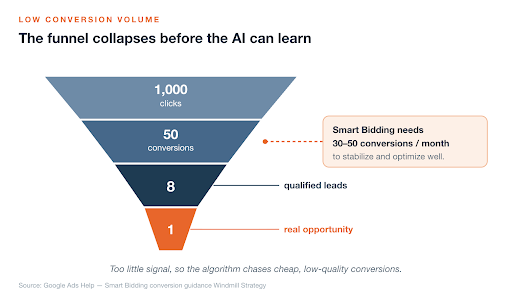
Google’s machine learning needs conversion data to optimize. Google’s own guidance recommends at least 30 conversions per month for Smart Bidding to work well, and several strategies perform better closer to 50. A manufacturer selling $250,000 custom automation systems might generate eight qualified leads in a strong month. With that little signal, the algorithm cannot learn what a real opportunity looks like, so it does the opposite of what you want: it chases the cheapest, easiest conversions it can find and floods your pipeline with high volume and low quality.
2. The Algorithm Optimizes Toward the Wrong “Conversions”
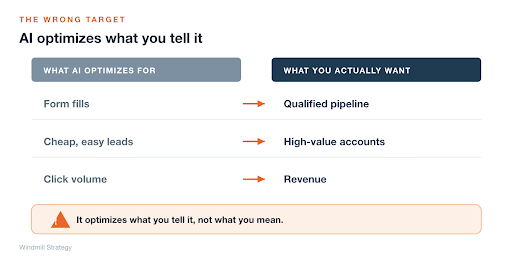
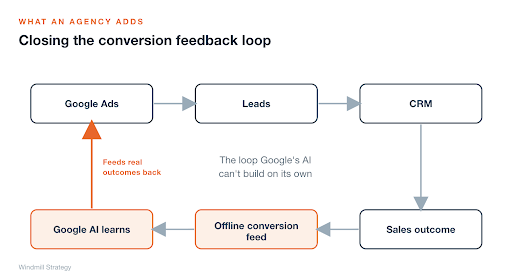
Performance Max will happily optimize toward form fills whether they come from a plant manager at a target account or a student researching a school project. Without careful conversion configuration (offline conversion tracking, CRM integration, and lead quality feedback loops), the AI optimizes for activity, not revenue. In long B2B sales cycles, where the real conversion event might happen 6 to 18 months after that first form fill, the gap between “a lead” and “a customer” is exactly where budgets quietly leak.
3. Performance Max Is a Black Box for Niche Audiences
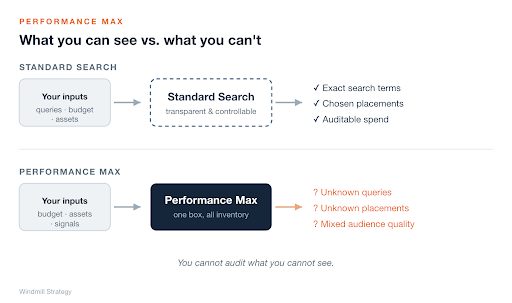
Performance Max, Google’s flagship AI campaign type, gives advertisers minimal control over where ads run, which searches they match, or which audiences get served. For consumer brands, that tradeoff often pays off. For Performance Max in B2B, say a company selling precision sensors to aerospace engineers, losing visibility into the placements, queries, and audiences behind your spend makes optimization, and fraud detection, nearly impossible.
4. Creative and Messaging Still Need Technical Expertise
Auto-generated headlines and descriptions pull phrases from your website and stitch them into combinations the algorithm predicts will perform. For technical products, that often produces awkward, imprecise, or flatly inaccurate messaging. An engineer searching for “316L stainless steel tubing tolerances” is not looking for a generic headline about “quality metal products,” and serving ads with a headline like this erodes both clicks and credibility.
5. Account Structure and Strategy Aren’t Automated
The decisions that matter most still sit with people. Which campaigns to run, how to segment by product line or buyer persona, how to allocate budget across funnel stages, when to use Search versus Performance Max versus LinkedIn: none of that is automated. Those choices drive most of the performance difference between a well-run account and a wasted budget, and no amount of machine learning makes them for you.
What a Good Agency Does That AI Can’t
The real value of an experienced team is not pushing buttons the algorithm could push for itself. It is the judgment that aims the algorithm at the right target in the first place. That work includes:
- Translating business goals into the right conversion events and conversion tracking architecture, so the algorithm optimizes toward revenue instead of noise.
- Building CRM and offline conversion integrations that feed real outcomes back into Google, so the AI learns what a good lead looks like, not just what a form fill looks like.
- Setting account structure, channel mix, and budget allocation around your sales cycle, deal size, and target account list.
- Writing technically accurate ad copy that speaks to engineers and technical buyers.
- Reviewing search query, placement, and audience reports to catch the waste that the algorithm will never flag on its own.
- Coordinating paid media with SEO, your website, and sales enablement so that campaigns drive qualified pipeline, not isolated clicks.
In other words, the algorithm executes, but the strategy is still human. For a fuller picture of how paid media fits with the rest of your program, see our digital marketing for manufacturers guide.
Is Google’s AI Ever Enough on Its Own?
It is fair to ask whether any scenario lets you simply switch on the automation and walk away. The closest case is high-volume, transactional e-commerce with clear ROAS targets and thousands of conversions a month to feed the model. There, the data volume is high enough and the conversion (a purchase) is unambiguous enough that the AI can largely run itself.
That is not B2B and industrial marketing, and it is not the work we typically do at Windmill Strategy. When deals are large, leads are scarce, sales cycles run for months, and a “conversion” is only the first step toward revenue, AI on its own is not a strategy. It is a powerful tool waiting for someone to point it in the right direction.
Google Ads Is Already an AI Platform
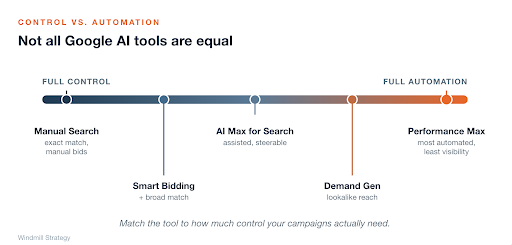
Here is the part many of these debates miss: AI is not a feature you can switch off. It is woven through the entire ad platform and has been for years. The practical question is not whether to use Google’s AI, but which AI-forward tools fit your situation and how tightly to steer them. A few of the most relevant:
- Dynamic Search Ads use Google’s AI to generate headlines on the fly from your website content, which often lifts ad relevance and click-through rates. They only work as well as the site behind them, so they depend on high-quality, unique content and a crawlable, well-indexed website with strong, unique page titles, as well as human discernment as to which pages should and shouldn’t be candidates as landing pages
- AI Max for Search is the next generation of Dynamic Search Ads, which are being upgraded to AI Max beginning in September 2026. It adds automatically created assets (text customization), final URL expansion (Google routes each user to the landing page it predicts will perform best), and search term matching (broad match and keywordless technology that expands your existing keywords toward higher-performing queries). It is not a fit for businesses that need tight control over ad copy or landing pages, or for regulated industries such as healthcare and pharmaceuticals, finance and banking, or defense.
- Performance Max (PMax) runs across all Google Ads inventory (Search, Display, YouTube, Discover, Gmail, and Maps) and applies AI to bidding, budget optimization, audience targeting, and creative, with Smart Bidding underneath. It needs strong visual creative including video, useful audience signals, a healthy budget to fuel its learning phase, and steady monitoring, since it can pull in high volumes of low-quality leads.
- Smart Bidding with broad match keywords lets Google’s AI optimize for conversions or conversion value, with or without a target CPA or ROAS, while broad match helps the algorithm learn faster and find new auctions. Comprehensive negative keywords and negative keyword lists are essential here to curb wasted spend, and regular Search Term Report reviews keep irrelevant queries in check.
- Demand Gen is currently the only campaign type that supports lookalike audiences built from your uploaded customer lists, which Google’s AI then uses to reach new users who most resemble your best existing customers.
Used deliberately, each of these has a place. The common thread is that none of them runs itself well in a technical B2B account without a clear conversion definition, the right guardrails, and a person reviewing the results.
Get More From Your Google Ads Budget
You do not have to choose between Google’s automation and human expertise. The best B2B paid ads management pairs them: let the AI do what it does well, and put experienced strategists in charge of what it cannot.
As an industrial digital marketing & PPC agency, Windmill Strategy runs Google Ads for manufacturers and other technical B2B companies, turning automation into qualified pipeline instead of wasted spend. We build the conversion tracking, account structure, and technically accurate messaging that point the algorithm toward revenue, not noise.
Not sure where your campaigns stand today? Our Digital Marketing Quick Start delivers a fast, focused assessment of your paid search, SEO, and website, plus a prioritized roadmap you can act on right away, with no long-term contract. Let’s put your budget to work on the leads that actually move your business.
Frequently Asked Questions
Can Google’s AI manage B2B Google Ads on its own?
It can manage the mechanics, but it optimizes only toward the goal and the data you give it. For high-volume, transactional e-commerce, that can be enough. For B2B and industrial companies with scarce leads and sales cycles that run 6 to 18 months, AI on its own tends to optimize toward cheap form fills rather than revenue. The judgment that points it at the right target still comes from people.
Why does Performance Max struggle for industrial companies?
Performance Max gives you little visibility into which queries, placements, and audiences spent your budget. For consumer brands that tradeoff often works, but for niche technical audiences it makes optimization and fraud detection difficult. It also needs strong creative, useful audience signals, and a healthy budget, and it requires regular monitoring because it can deliver high volumes of low-quality leads.
How many conversions does Smart Bidding need to work well?
Google recommends at least 30 conversions per month for Smart Bidding to perform well, and several strategies do better closer to 50. Many B2B and industrial accounts never reach that volume, since a single deal can be worth six figures and qualified leads are scarce. With too little data, the algorithm cannot learn what a good lead looks like and defaults to chasing easy, low-value conversions.
How do you keep Google Ads AI from optimizing toward bad leads?
Feed it better signals. That means defining the right conversion events, setting up conversion tracking and offline conversion imports, and connecting your CRM so closed deals, not just form fills, flow back into Google. Once the AI learns what a qualified lead actually looks like, it optimizes toward revenue instead of activity. Improving lead quality is usually a bigger lever than adjusting bids.
What is AI Max for Search, and should industrial companies use it?
AI Max for Search is Google’s next-generation replacement for Dynamic Search Ads, which begin upgrading automatically in September 2026. It uses automatically created assets, final URL expansion, and broader search term matching to find more queries. It is not a good fit if you need tight control over ad copy or landing pages, or if you operate in a regulated field such as healthcare, finance, or defense.
Should we use Performance Max or Search campaigns for B2B?
For most B2B and industrial advertisers, standard Search campaigns offer the control and visibility that technical selling demands, while Performance Max works better as a supporting tactic once your tracking is solid. The right mix depends on your sales cycle, deal size, and how much control you need over messaging. An experienced industrial PPC agency can map campaign types to your funnel rather than letting the platform decide for you.
What does an agency do that Google’s AI can’t?
The high-value work is judgment, not button-pushing: defining the right conversion events, building CRM and offline conversion feedback, structuring the account around your buyers, writing technically accurate ad copy, and catching wasted spend the algorithm will never flag. If you want a fast read on where your account stands, a Digital Marketing Quick Start gives you a prioritized roadmap you can act on right away.