

Why We Built Aerovane™: A More Transparent Way to Measure AI Visibility
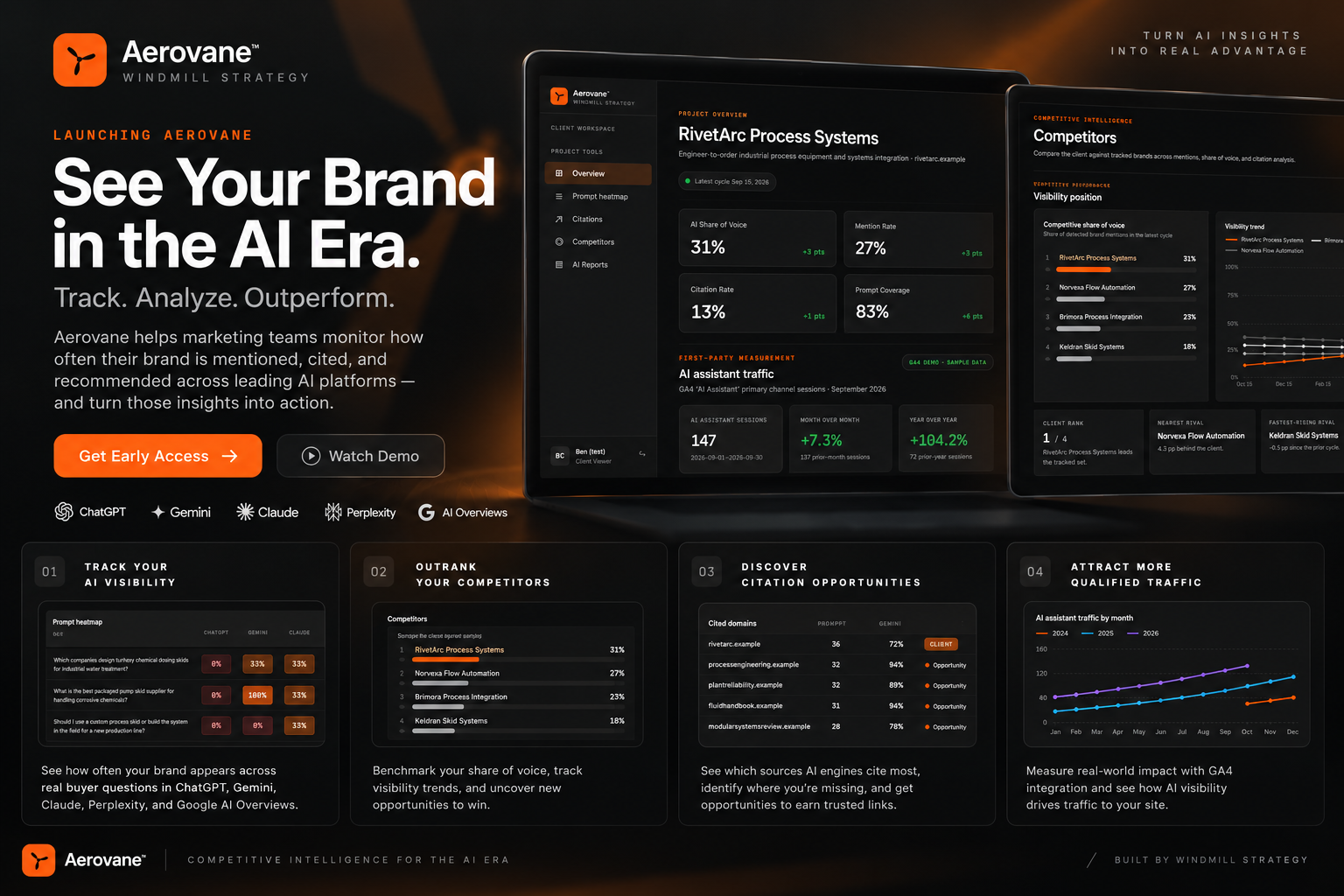
AI-generated answers are becoming part of the B2B buying process.
Prospective customers are using ChatGPT, Google AI Overviews, Gemini, Claude, Perplexity, and other AI experiences to research unfamiliar topics, understand technical solutions, compare vendors, and build shortlists.
For companies with complex products or services, that raises important questions:
- Does the brand appear when buyers ask relevant questions?
- How accurately do AI platforms describe its capabilities?
- Which competitors are recommended?
- What sources are shaping the answers?
- Is AI visibility improving as SEO and content initiatives are implemented?
Like many agencies, we initially looked to existing AI visibility platforms for the answers.
We spent months testing leading tools. We reviewed their dashboards, compared their metrics, and considered how they might fit into our client engagements.
We came away unimpressed.
Not because the concept of AI visibility monitoring lacked value. It clearly had value. The problem was that we could not consistently connect the reported metrics to a transparent, defensible methodology—or justify the ongoing cost relative to the value those tools provided.
So we built Aerovane™.
- We didn’t want to hand clients a score we couldn’t explain
- We could afford the subscriptions. We couldn’t justify the value.
- We needed a platform that fit our workflow
- What we built
- Overview: The complete visibility picture
- Prompt Heatmap: Visibility at the question level
- Manage Prompts: Monitoring the right questions
- Competitors: Understanding who AI platforms recommend
- Citations: Seeing which sources influence the answers
- Annotations: Giving the data context
- What transparency looks like in practice
- Built for service, not software margin
- What comes next
- Want to understand how your brand appears in AI search?
We didn’t want to hand clients a score we couldn’t explain
Many AI visibility products present polished scores, percentages, and rankings. But when we tried to look beneath those numbers, basic questions were often difficult to answer.
Which prompts were included?
How were those prompts weighted?
Which models or platforms contributed to the score?
How many responses were sampled?
What qualified as a brand mention?
Were citations measured separately from mentions?
Was the metric based on the percentage of prompts, the percentage of responses, or some proprietary combination of factors?
A metric can appear precise while still being difficult to evaluate.
That does not necessarily mean the metric is wrong. It means we cannot independently determine how much confidence to place in it, and we cannot clearly explain it to a client.
That was a problem for us.
Transparency is central to how Windmill approaches analytics and reporting. If we are going to use a number to guide strategy or assess performance, we need to understand what it represents, how it was calculated, and what its limitations are.
We did not want to tell a client that their AI visibility score was 43 without being able to explain exactly what 43 meant.
With Aerovane, we know the prompt set, platform mix, sample size, mention criteria, citation logic, and calculation behind the reported metrics. We can explain the results in plain English and put them in the appropriate strategic context.
We could afford the subscriptions. We couldn’t justify the value.
The cost of leading AI visibility platforms was another concern.
This was not simply a question of whether Windmill could afford the software. We could.
The question was whether the cost produced enough value for our clients.
As usage expanded across multiple client accounts, the monthly investment required to collect AI visibility data increased quickly. Those costs would ultimately become part of the cost of providing the service.
Every dollar spent on unnecessary tooling overhead is a dollar that cannot be spent on strategic thinking, research, content, technical improvements, analysis, or implementation.
We were not looking for the cheapest possible solution. We were looking for a defensible one.
By building Aerovane, we understand what each scan costs, which activities use paid data, and how those costs change as prompt sets or sampling frequencies expand. That visibility allows us to collect the information we need while keeping the economics aligned with the actual value being delivered.
We needed a platform that fit our workflow
The third issue was flexibility.
When relying on someone else’s product, a feature request becomes a conversation with a product manager. That request must be prioritized against other customers’ needs, added to a roadmap, designed, developed, and eventually released, if it is accepted at all.
That process is understandable. It is also limiting when the software is central to your service.
We wanted AI visibility monitoring to connect with the way Windmill already handles SEO strategy, reporting, competitive research, analytics, annotations, and client communication.
When we identify an opportunity to improve Aerovane, we do not have to play telephone with another company’s product team or remain handcuffed to its development timeline.
We can define the feature, build it, test it, and implement it when we believe it is ready.
That does not mean adding features simply because we can. It means the platform can evolve around practical client needs instead of forcing our process to evolve around a generic software product.
What we built
Aerovane is the AI visibility measurement and reporting platform behind Windmill’s work.
It collects structured samples across Google AI Overviews, ChatGPT, Gemini, Claude, and Perplexity. It organizes those results around prompts that are relevant to each client’s products, services, industries, audiences, and competitors.
It then helps our team answer three fundamental questions:
- Where is the client visible?
- What appears to be influencing that visibility?
- What should we do next?
The following sections provide a closer look at the core features.
Overview: The complete visibility picture
The Overview gives our strategists and clients a high-level picture of AI visibility performance.
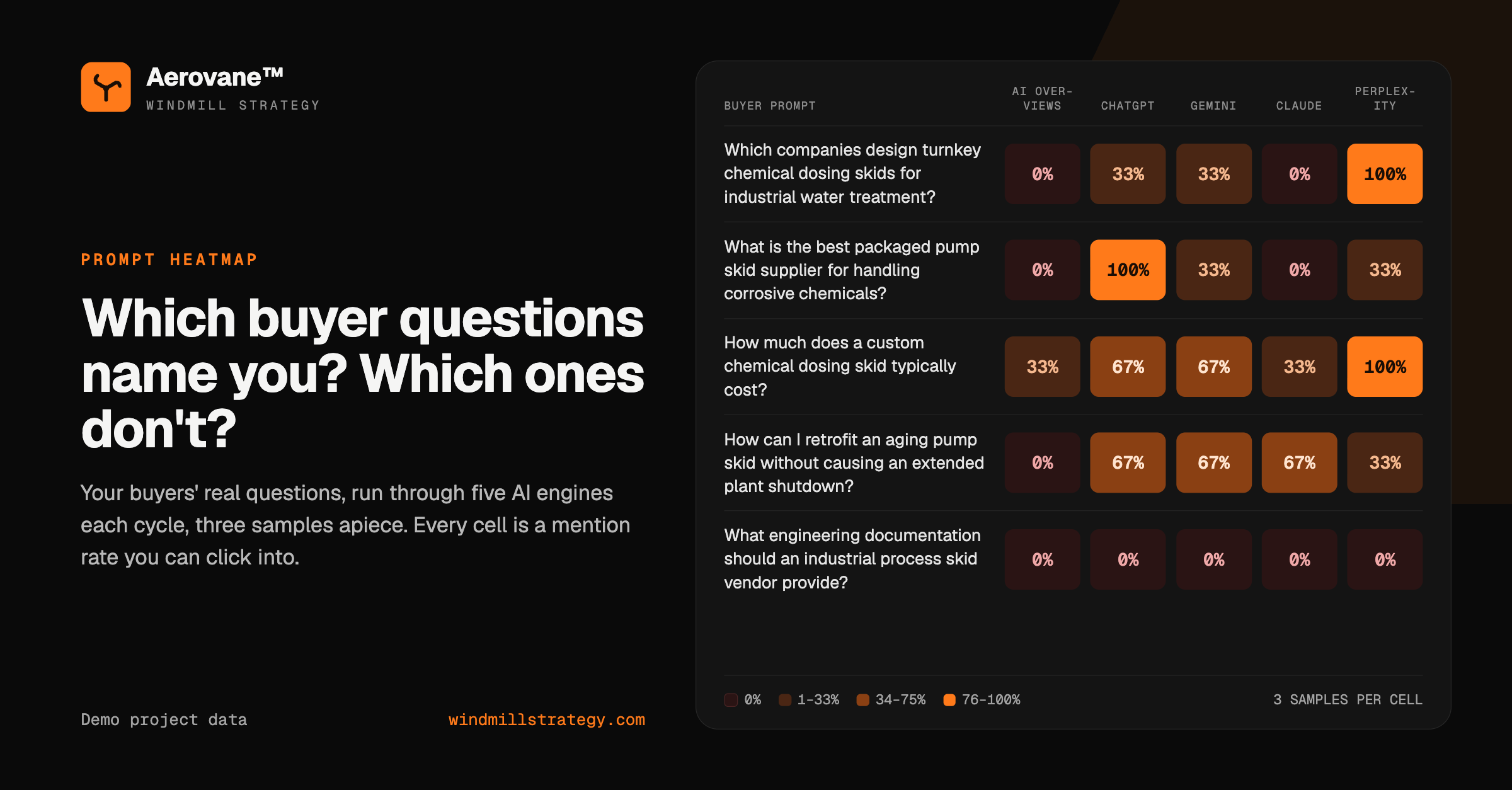
It brings together current visibility, historical trends, platform-level results, competitive movement, AI referral traffic, and recent alerts. Instead of opening several reports to understand what happened, users can begin with a concise view of the most important changes.
The purpose is not to reduce a complex search environment to a single score. The purpose is to help someone quickly identify where a deeper investigation is warranted.
For example:
- Is overall visibility increasing or declining?
- Is one AI platform performing differently from the others?
- Is a competitor gaining ground?
- Are sampled visibility gains accompanied by more AI referral traffic?
- Did a recent strategic initiative correspond with a measurable change?
Prompt Heatmap: Visibility at the question level
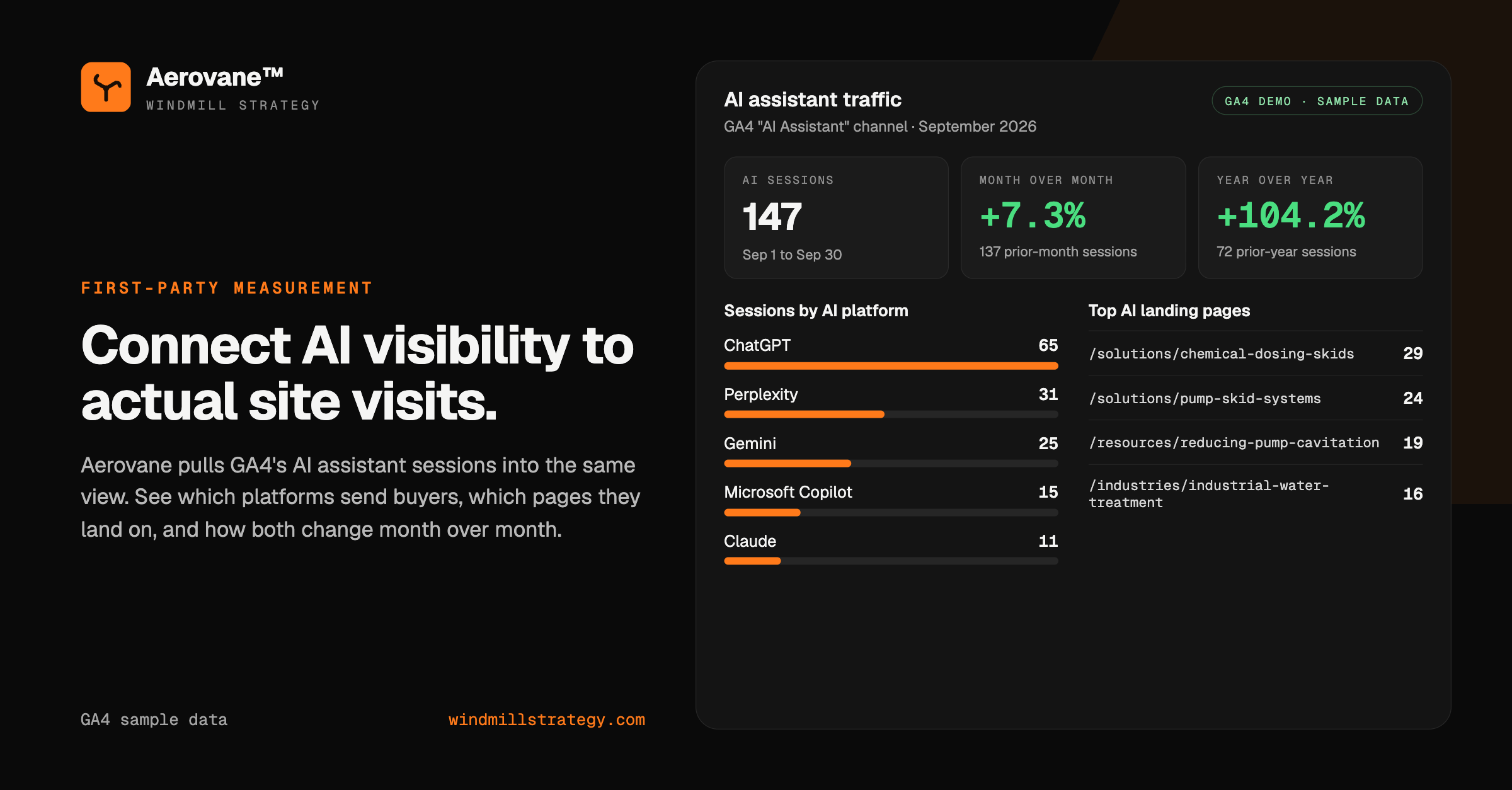
Aggregate numbers are useful, but they can hide meaningful differences between individual buyer questions.
The Prompt Heatmap shows how the brand performs for each monitored prompt across:
- Google AI Overview
- ChatGPT
- Gemini
- Claude
- Perplexity
This makes it possible to see where visibility is broad, where it depends on a single platform, and where the brand is absent altogether.
A company might appear consistently for high-level category questions but disappear when a buyer asks about a specialized application. Another might be mentioned by ChatGPT and Claude but omitted from Google AI Overviews.
Those distinctions are much more actionable than a generalized visibility score.
The heatmap also helps our strategists prioritize opportunities. A commercially important prompt with weak visibility may justify new content, stronger supporting evidence, technical improvements, or additional authority-building efforts.
Manage Prompts: Monitoring the right questions
An AI visibility platform is only as useful as the prompts it monitors.
If the prompt set does not reflect how buyers research, the resulting data may look impressive while saying very little about business performance.
Manage Prompts is where we maintain the strategic questions used for each client. These can reflect:
- Products and services
- Technical problems
- Applications and use cases
- Industry-specific needs
- Vendor comparisons
- Buying considerations
- Educational questions
- High-value areas of expertise
We intentionally prioritize relevance over raw prompt volume.
The goal is not to generate the largest possible dataset. It is to monitor a focused set of questions that can reveal whether a company is becoming more visible during meaningful parts of the buying process.
Competitors: Understanding who AI platforms recommend
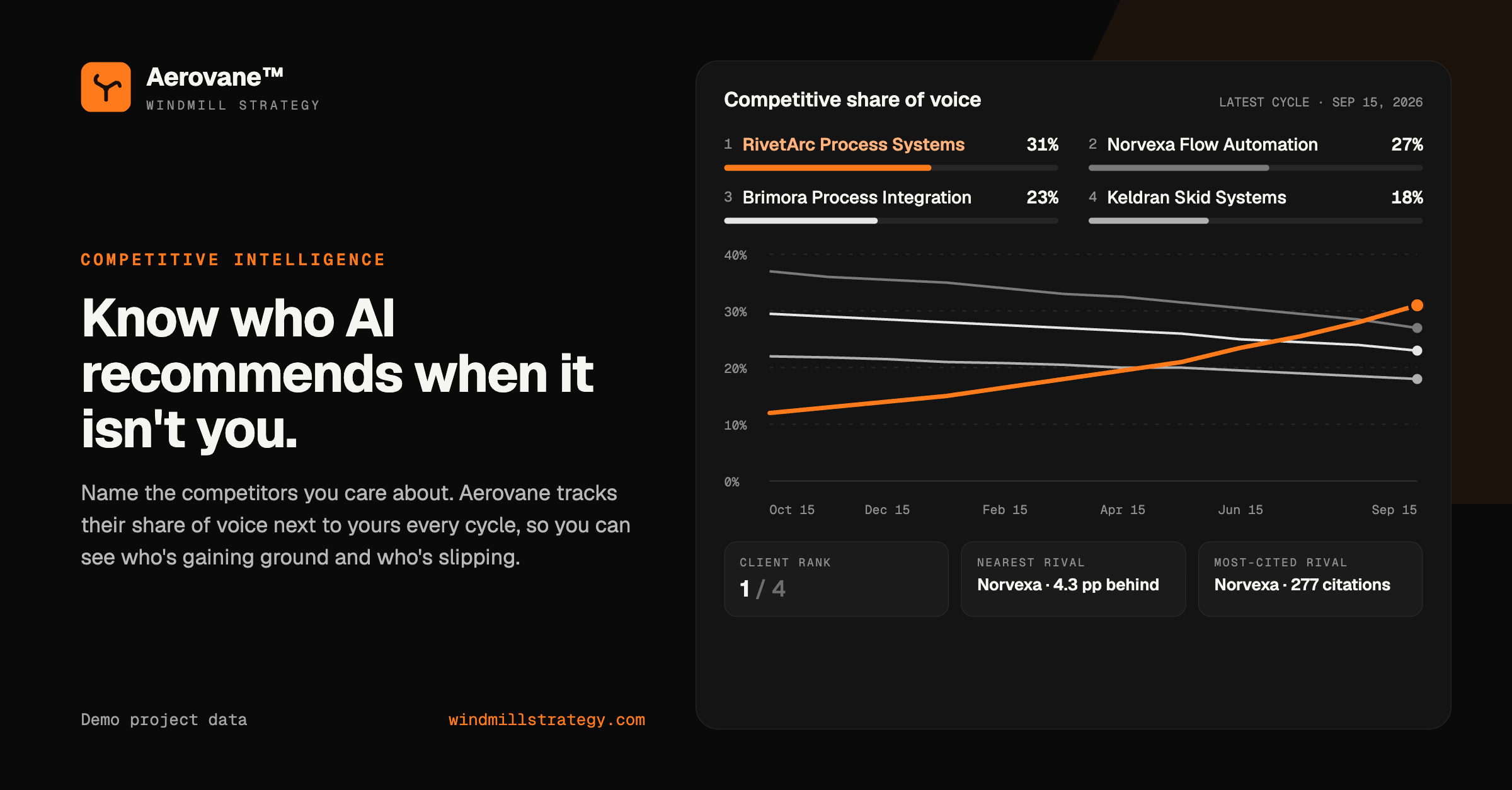
AI-generated answers often introduce several vendors or solutions at once.
The Competitors section shows which companies appear alongside the client, how frequently they are mentioned, and how visibility changes over time.
This creates a more useful competitive picture than simply asking whether the client was present.
We can investigate:
- Which competitors dominate a particular topic
- Where a smaller competitor is gaining visibility
- Which platforms favor different competitive sets
- Whether the client is closing or widening a visibility gap
- Which subjects present the clearest opportunities for differentiation
These insights can inform content strategy, positioning, digital PR, website architecture, and traditional SEO priorities.
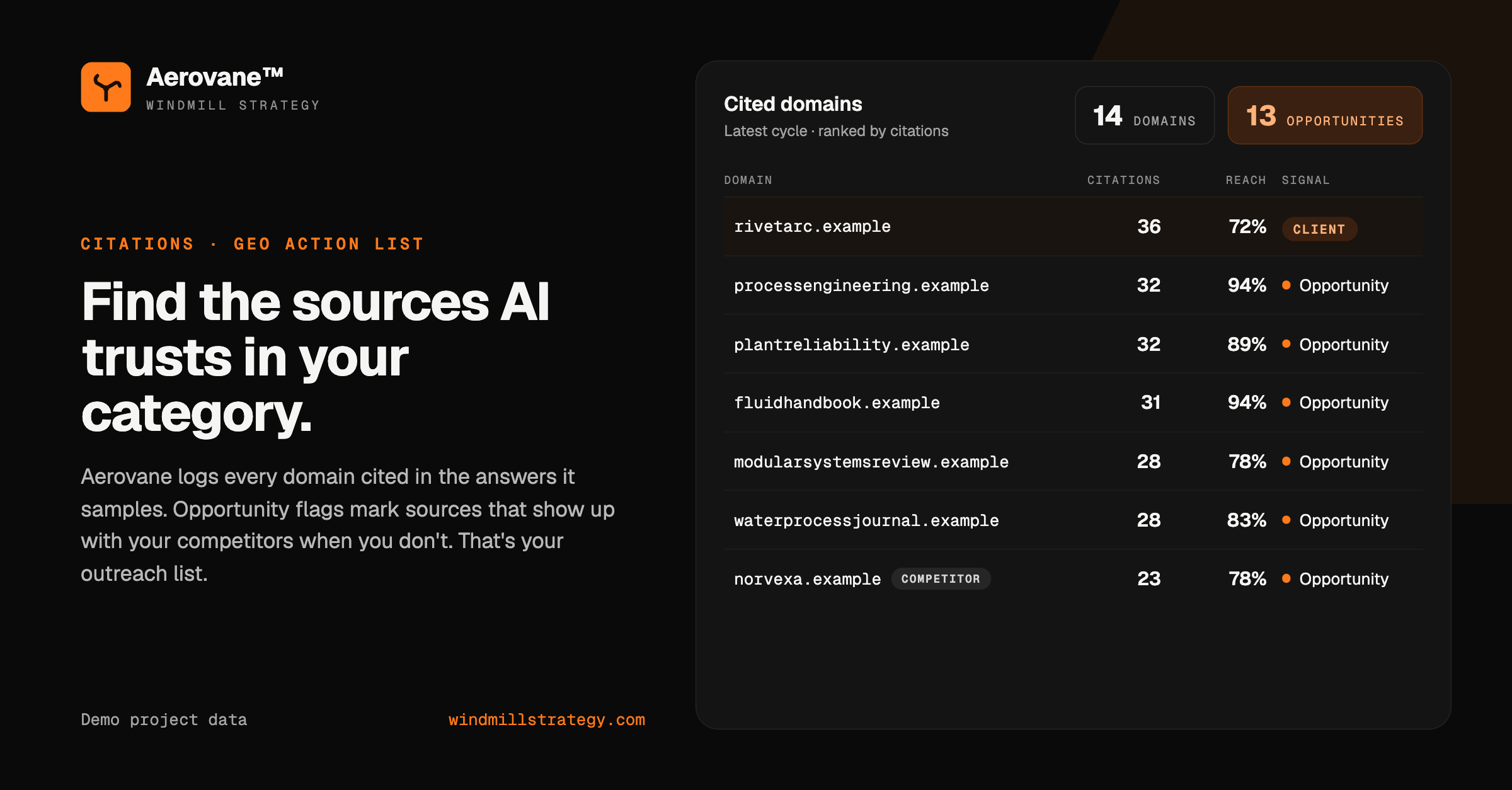
Citations: Seeing which sources influence the answers
A brand mention and a citation are not the same thing.
An AI platform may mention a company without linking to its website. It may cite a competitor, an industry publication, a distributor, a directory, an association, or another third-party source.
The Citations section identifies the domains and pages referenced in sampled answers.
This helps us understand the information ecosystem behind AI visibility.
If AI platforms repeatedly cite a particular publication, directory, or association, that source may represent an authority-building or digital PR opportunity. If a competitor’s educational content is frequently cited, we can study what makes that content useful. If a client is mentioned but its website is rarely referenced, stronger first-party resources may be needed.
Citations do not provide a complete explanation of how an AI system formed an answer. They do, however, give us observable evidence about the sources the platform chose to surface.
Annotations: Giving the data context
Performance does not change in a vacuum.
A new service page may launch. A major content optimization may go live. The client may receive significant media coverage, update its positioning, launch a product, change its domain, or attend an important industry event.
Annotations allow us to record those developments alongside performance data.
This does not prove that an individual event caused a specific increase or decrease. It creates a more informed timeline for analysis.
Instead of looking at a trend and asking, “What happened here?” months later, we can connect the data to a documented history of strategic activity.
What transparency looks like in practice
Building Aerovane gives us control, but control alone is not the point.
The real advantage is accountability.
We can distinguish between sampled AI visibility and actual referral traffic. We can document which prompts and platforms contributed to a metric. We can retain historical runs, monitor changes, examine the underlying responses, and understand the cost of collecting the data.
We can also be candid about limitations.
AI-generated answers can vary. Platforms change their models and interfaces. Responses may differ by time, location, account state, personalization, or other factors outside our control. No monitoring platform can observe every possible answer presented to every possible user.
Aerovane does not eliminate that uncertainty. It gives us a transparent and repeatable way to sample the environment, identify patterns, and monitor meaningful changes over time.
That is a more honest and more useful foundation for strategy.
Built for service, not software margin
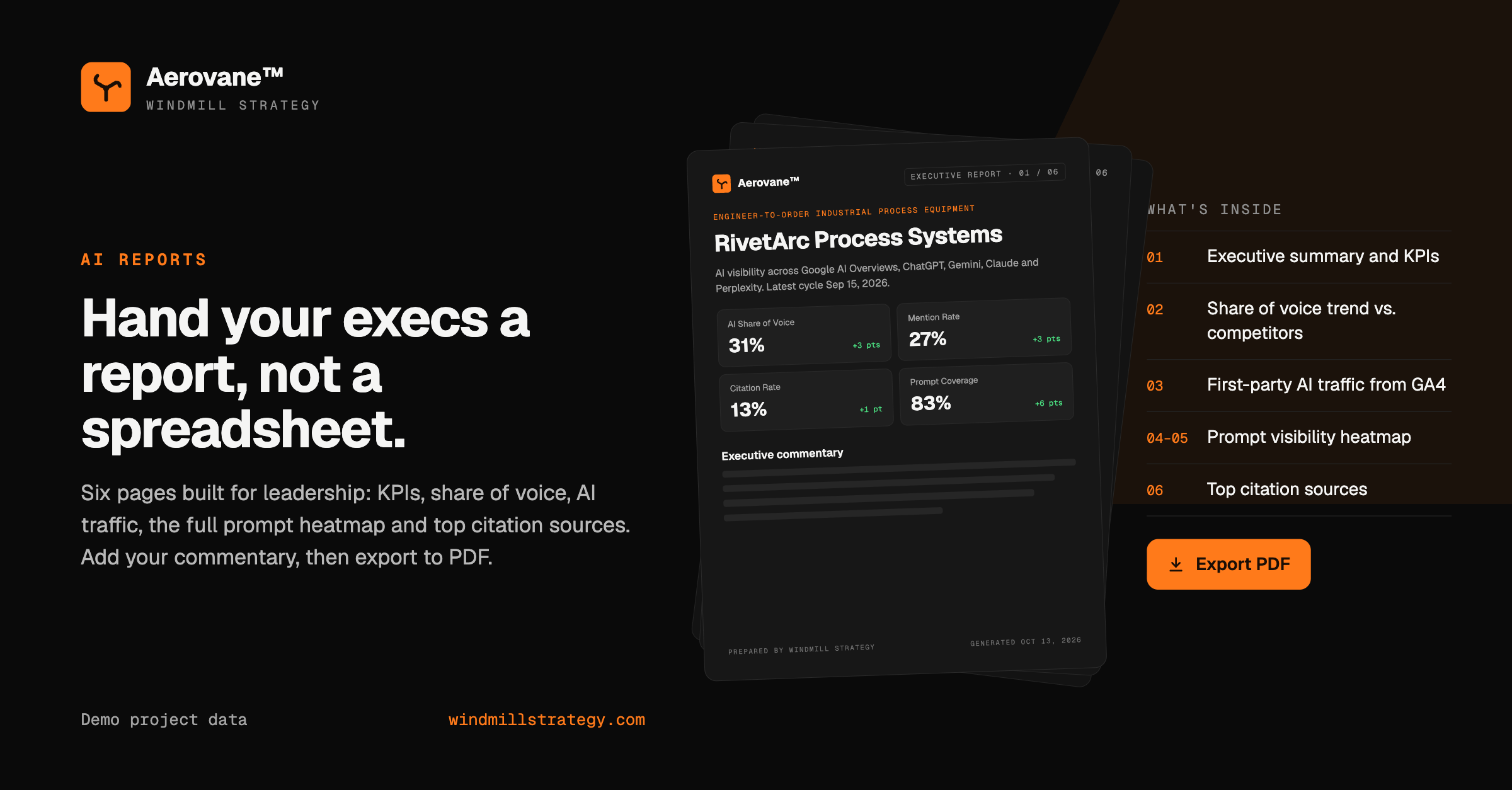
Aerovane is not an attempt to become another software company selling access to another dashboard. It is not sold as a standalone software product or tool; rather, it is used exclusively within Windmill’s client engagements to enhance our overall service delivery.
We built it to improve the work we do for our clients.
It allows us to:
- Fit AI visibility monitoring into our proven SEO workflows
- Explain performance without hiding behind proprietary scores
- Keep data-collection costs proportional to the value delivered
- Connect visibility findings with strategic initiatives
- Adapt the platform as client needs and AI search evolve
- Spend a larger percentage of our time in client engagements on analysis and implementation
Ultimately, this is about providing a higher level of service.
Our clients hire Windmill to help them become more visible, communicate complex value, attract the right buyers, and own their niche. As AI becomes a more influential part of research and discovery, we need tools that support those outcomes without compromising transparency.
The leading platforms we tested did not give us the combination of clarity, flexibility, and value we were looking for.
So we built it ourselves.
What comes next
Aerovane will continue to evolve.
As our strategists identify new questions, reporting needs, and opportunities, we can test and implement improvements directly. Some ideas will prove valuable and become permanent parts of the platform. Others may not, and that is part of building a tool around real work rather than an abstract product roadmap.
What will remain consistent is the reason Aerovane exists:
To help Windmill provide the highest possible level of strategy, service, and transparency to our clients, and help those clients own their niche and their business trajectory.
Want to understand how your brand appears in AI search?
Windmill Strategy can help you assess where your company is visible, which competitors and sources are shaping the conversation, and what opportunities should be prioritized next.