

Our First 30 Days with ChatGPT Ads: What We Learned from an Early B2B Pilot

Artificial intelligence is changing how people search for information, research vendors, and evaluate solutions. As AI assistants become a larger part of the buying journey, they’re also creating new opportunities for advertisers to reach potential customers.
One of the newest entrants into the digital advertising landscape is ChatGPT Ads, OpenAI’s self-service advertising platform that allows businesses to display sponsored content alongside relevant ChatGPT conversations. While the platform is still in its early stages, it represents a fundamentally different approach to advertising than traditional search engines.
At Windmill Strategy, we’re committed to staying ahead of emerging trends and technologies that have the potential to impact B2B marketing. Before recommending any new platform or tactic to our clients, we believe in evaluating it firsthand to understand how it works, where it excels, where it falls short, and whether it can deliver meaningful business results.
So we became our own test subject.
Over the course of one month, we launched two campaigns promoting our own agency services to determine whether ChatGPT Ads could become a viable lead generation channel for industrial and manufacturing B2B companies.
This case study outlines how we structured the test, what we learned, and where we believe the platform shows promise.
What Is ChatGPT Ads?
ChatGPT Ads is managed through OpenAI Ads Manager, a self-service platform introduced in 2026. Unlike traditional search advertising where ads are matched primarily to keyword searches, ChatGPT Ads are shown beneath relevant AI conversations when the platform determines an advertiser’s offering is helpful to the user’s discussion.
Currently, ads are shown only to Free and Go users in the United States, Canada, Australia, New Zealand, Brazil, Japan, Korea, and the United Kingdom. Ads are not shown to users on Plus, Pro, Business or Enterprise plans, users under 18, temporary chats, logged-out users, image-generation conversations, or ChatGPT Atlas.
Each ad includes:
- Advertiser name
- Company logo
- Headline
- Short description
- Image
- Landing page URL
The experience is intentionally lightweight and designed to feel like a relevant recommendation rather than an interruption.
How Audience Targeting Works
One of the biggest differences between ChatGPT Ads and platforms like Google Ads or LinkedIn Ads is how targeting works.
There are no keyword match types, search terms reports, demographic targeting, remarketing audiences (unless you have a list of at least 25,000 matched users, which most SMBs do not), device targeting, scheduling, or detailed geographic controls. During our test, country-level targeting was the only location option available.
Instead, advertisers provide Context Hints.
Context Hints are rich descriptions, set at the ad group level, that explain:
- Who your ideal customer is
- What problems they are trying to solve
- The products or services you offer
- Relevant industries
- Common buying questions
- Keywords or topics relevant users may discuss
OpenAI then uses these signals — along with the landing page, ad copy, and conversation context — to determine when an ad is relevant enough to display. Context Hints are not keywords and don’t guarantee that ads will appear for any specific query; instead, they help the AI understand the types of conversations where your business may be useful.
| 🔍 Google Ads | 💬 ChatGPT Ads |
| Keywords | Context Hints |
| Match Types | Conversation Intent |
| Search Queries | Natural Language |
| Search Intent | Conversation Context |
| Keywords Trigger Ads | AI Determine Relevance |
For companies selling complex B2B solutions, this contextual approach is especially interesting because buying journeys often begin with educational questions rather than simple keyword searches.
Why We Ran This Test
As a consultative digital marketing agency specializing in B2B industrial, manufacturing, engineering, technical, and life sciences companies, we wanted to answer several questions:
- Could ChatGPT Ads reach our niche audience?
- How expensive would clicks be compared to Google Ads?
- How would clickthrough rates (CTR) compare to Google Ads Search campaigns?
- Would conversation-based targeting produce quality traffic?
- How should campaigns be structured?
- What creative and landing page strategies work best?
Our goal wasn’t simply to generate leads — it was to establish a performance benchmark while learning how the platform behaves.
Campaign Structure
We created two separate campaigns based on industry (manufacturing and industrial) and launched them on June 22, 2026. Each campaign contained three service-specific ad groups:
- Website Design & Development
- SEO
- Marketing Strategy
Within every ad group, we created four ads — two landing page tests and two creative (image) tests. All ads contained the same headline and description as a control. This campaign structure allowed us to test multiple variables simultaneously while maintaining tightly focused Context Hints for each target industry.
Building Our Context Hints
Rather than writing generic audience descriptions, we built our Context Hints using multiple sources of first-party marketing data. These included:
- Our highest-converting Google Ads keywords from the previous 12 months
- Trends and themes from a recently conducted lead quality and search term analysis
- Additional high-value keywords that hadn’t yet generated conversions but were still highly relevant
- Key messaging from our website describing what we do, services we offer, and the geographic areas we serve
- Detailed descriptions of our ideal customer profile
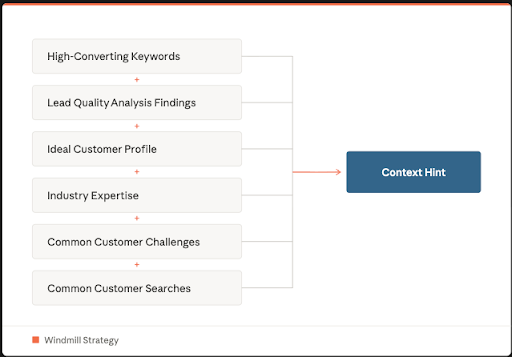
Our ideal prospects are marketing leaders at established, mid-sized, B2B industrial, manufacturing, engineering, technical, and life sciences companies. These businesses typically sell complex products, have long sales cycles, market to engineers or technical buyers, and are looking for strategic marketing partners rather than tactical vendors.
We developed separate Context Hints for the Industrial and Manufacturing campaigns while keeping them consistent across each campaign’s ad groups.
Budget, Bidding and Measurement
Although OpenAI states that there are no minimum spend requirements, we found during campaign setup that daily budgets must be set to at least $25 per campaign. Since this was an exploratory pilot, we intentionally kept the budget modest at the minimum $25 per day resulting in a total spend of $1,470 over the first month.
We optimized campaigns for clicks since optimizing for conversions was not yet available.
Though ChatGPT Ads defaults to a maximum cost-per-click (CPC) of $3.50, we increased our maximum bid to $20 because our Google Ads Search campaigns frequently generate average CPCs of $20+. Our objective was to establish realistic CPC benchmarks rather than artificially limiting delivery.
For measurement, we implemented website conversion tracking through both Google Tag Manager and the OpenAI Ads platform, tracking contact form and footer form submissions as our primary conversion events.
Results After One Month
| Metric | Manufacturing Campaign | Industrial Campaign |
| Spend | $725 | $745 |
| Impressions | 21,004 | 18,280 |
| Clicks | 136 | 123 |
| CTR | 0.65% | 0.67% |
| Avg. CPC | $5.33 | $6.06 |
| Avg. CPM | $34.52 | $40.75 |
| Conversions | 0 | 0 |
* CTR = click-through rate; CPC = cost per click; CPM = cost per 1,000 impressions
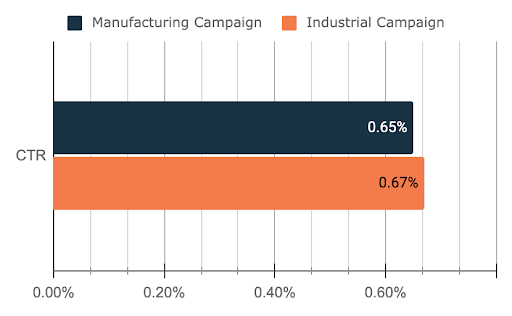
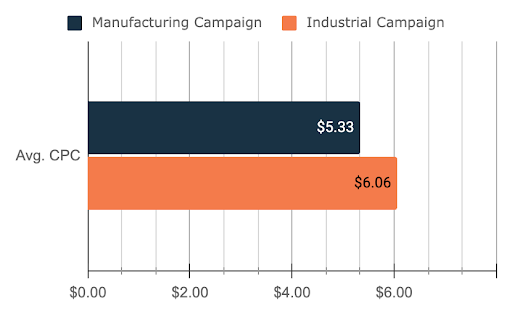
Combined, the campaigns spent a total $1,470 and generated:
- 39,284 impressions
- 259 clicks
- 0 conversions
- Overall avg. CTR of 0.66%
- Overall avg. CPC of $5.68
What We Learned
1. CPCs Were Much Lower Than We Expected
The biggest surprise was cost.
Although we allowed bids up to $20 per click, average CPCs settled between $5 and $6 — roughly one-third (or less) of what we regularly pay for comparable Google Ads Search traffic. Whether that pricing remains as advertiser competition increases remains to be seen, but it was an encouraging early signal.
2. The Platform Delivered Meaningful Visibility and Engagement
Nearly 40,000 impressions in one month demonstrates that ChatGPT already has sufficient inventory to deliver measurable exposure, even for a niche agency focused exclusively on mid-market B2B industrial and manufacturing companies.
Clickthrough rates (CTR) were remarkably consistent across both campaigns, with the Manufacturing campaign achieving a 0.65% CTR and the Industrial campaign a 0.67% CTR. While these figures don’t necessarily indicate exceptional performance on their own, they suggest that ChatGPT was able to identify relevant opportunities to present our ads to users interested in industrial and manufacturing marketing topics. As with any new advertising channel, CTR benchmarks for ChatGPT Ads are still emerging making it difficult to draw direct comparisons with more mature platforms like Google Ads or LinkedIn Ads. However, using our own historical performance data in Google Ads and LinkedIn Ads as benchmarks, we found that CTRs from ChatGPT Ads were comparable with what we typically see in a LinkedIn Ads Lead Gen or Sponsored Content campaign, or a Google Ads Display campaign.
To better understand post-click engagement, we analyzed user behavior in Google Analytics 4. We found that 100% of website visitors from our ChatGPT Ads campaigns were new users, indicating the platform successfully introduced our brand to new audiences. Approximately half of all sessions qualified as engaged sessions (51.2% session engagement rate), meaning users either spent more than 10 seconds on the site, viewed two or more pages, or completed a key event. Visitors also spent an average of 1 minute and 29 seconds on the website.
For context, during the same reporting period (June 22–July 21, 2026), the website’s overall engagement rate across all traffic sources was 57.0%, compared to 51.2% for ChatGPT Ads traffic. Likewise, the avg. session duration across all channels was 2 minutes and 46 seconds, compared to 1 minute and 29 seconds for visitors arriving from ChatGPT Ads.
3. Contextual Targeting Is Promising
Unlike keyword-based advertising, ChatGPT attempts to understand why someone is asking a question before deciding whether an ad is relevant. For organizations selling complex products with long buying cycles, this could become one of the platform’s greatest strengths. Instead of matching only explicit searches, advertisers have the opportunity to appear during broader research and discovery conversations.
Rather than simply telling the platform to show ads for terms like “industrial website design” or “manufacturing SEO,” we described who our ideal customers are, what they’re trying to accomplish, why they’re searching, and what kinds of conversations they’re likely to have before selecting a marketing partner. For B2B industrial, manufacturing, and technical companies, this can be especially valuable because purchasing decisions rarely begin with a simple product search. Buyers often start by asking broader questions, like:
- “What type of conveyor system is best for heavy pallet loads?”
- “How can I reduce scrap on our production line?”
- “Why are we getting inconsistent weld quality?”
- “How do I troubleshoot a PLC communication issue?”
These research-oriented conversations may never trigger a traditional keyword-based campaign, but they can represent high-value opportunities to introduce your brand early in the buying journey.
Our biggest takeaway is that B2B marketers should think less like paid search specialists and more like sales consultants. Instead of asking, “What keywords do my customers search?”, ask: “What conversations are my ideal customers having before they’re ready to buy?”
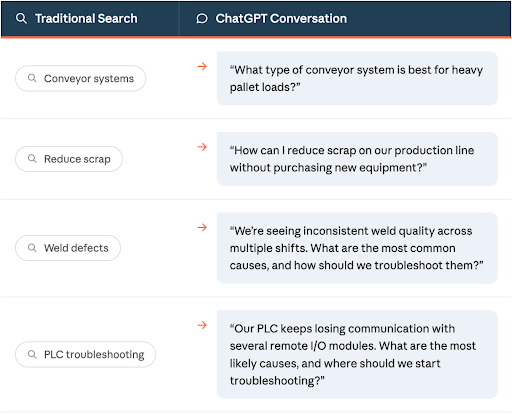
The more accurately your Context Hints describe those conversations (and the people having them), the better positioned ChatGPT is to determine when your ads can add value.
4. More Optimization Is Needed for Lead Generation
Neither campaign generated a tracked website conversion during the first month. While that’s obviously not the result we hoped for, it doesn’t necessarily mean the platform isn’t viable. As noted above, the current campaigns are doing well in terms of generating awareness. Also, this was an intentionally controlled pilot designed to establish baseline metrics — not a fully optimized lead generation program. Like any new advertising platform, effective performance will likely require multiple rounds of testing and refinement (challenge accepted, ChatGPT Ads…).
Potential optimization areas include:
- Refining Context Hints
- Testing additional creative concepts
- Expanding landing page variations
- Experimenting with future bidding options as the platform evolves
- Continuing to iterate messaging based on performance data
- Testing a conversion-optimized bid strategy once available
Final Thoughts
Our first month with ChatGPT Ads accomplished exactly what we intended: it gave us a practical understanding of how the platform works and established baseline performance metrics that we can build upon. While we didn’t generate conversions during this initial pilot, we came away with several encouraging findings. The platform delivered meaningful reach within our niche, average CPCs were significantly lower than expected, and the contextual targeting model appears well suited for complex B2B buying journeys.
While it’s still early days for ChatGPT Ads, this pilot gave us valuable insights into the platform’s capabilities, limitations, and potential. We’ll continue monitoring its evolution and evaluating where it can fit into the digital marketing strategies of the industrial, manufacturing, and technical companies we serve.
Ready to Put Paid Ads to Work for Your Business?
Emerging platforms like ChatGPT Ads are worth watching, but the right paid strategy for your company depends on your goals, your audience, and where your best leads already come from. You don’t have to sort that out alone or commit to a full engagement to get clarity.
Our Digital Marketing Quick Start is a focused, low-commitment way to evaluate your paid advertising and broader digital marketing opportunities. We’ll help you pinpoint where your budget will work hardest — whether that’s Google Ads, LinkedIn, an emerging channel like ChatGPT Ads, or some combination — and hand you a practical plan to move forward.
Curious what paid ads could do for your pipeline? Let’s talk.