

About Magnetic Inspection Laboratory
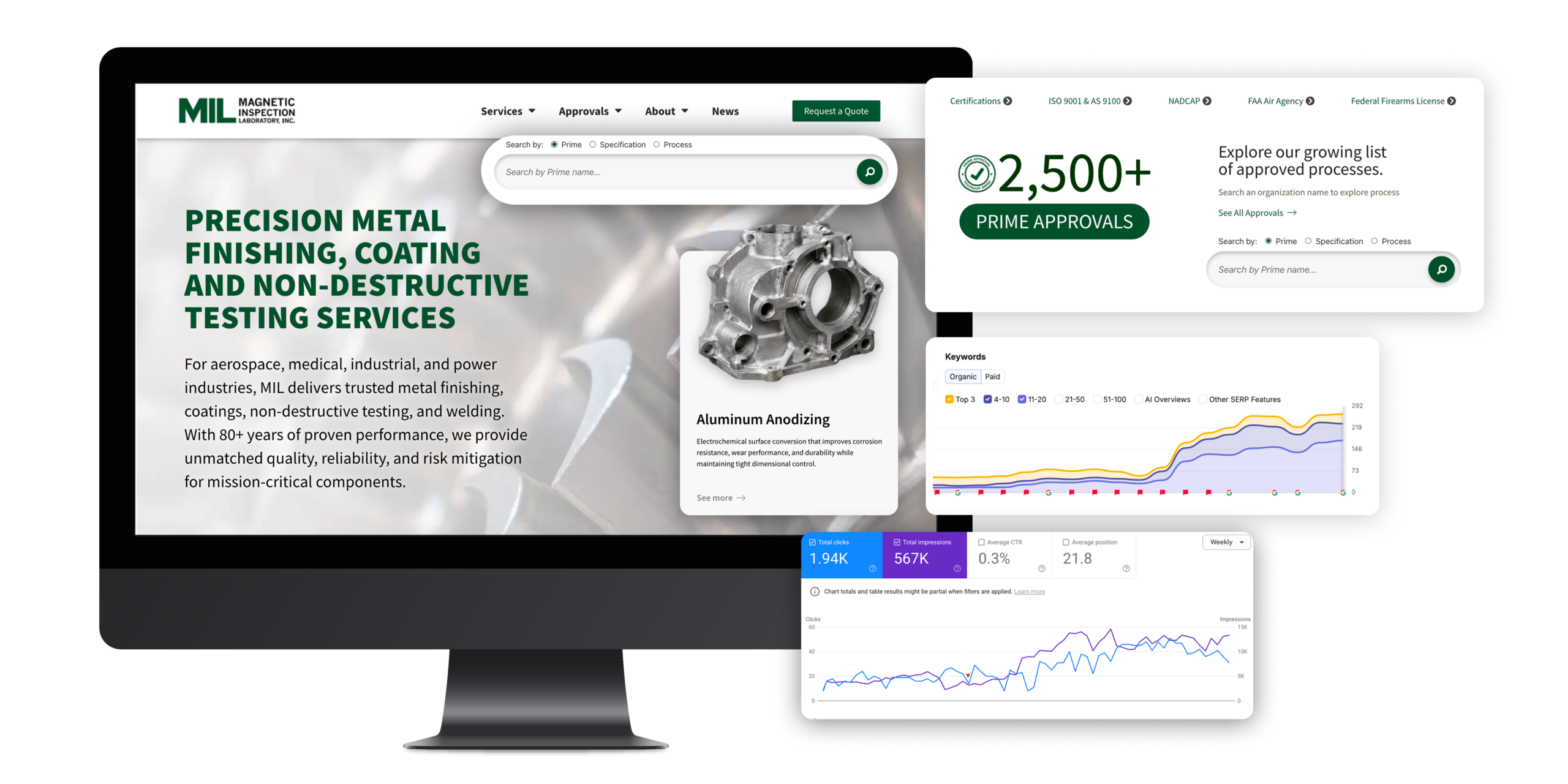
Founded in 1942 and based in Elk Grove Village, Illinois, Magnetic Inspection Laboratory provides metal finishing, coatings, non-destructive testing, precision welding, and surface enhancement services to the aerospace, defense, medical, industrial, and power generation industries. MIL holds ISO 9001 and AS9100 certification, NADCAP accreditation, and an FAA Air Agency certificate, along with more than 2,500 prime approvals from OEMs including Boeing, Lockheed Martin, Raytheon, Sikorsky, Rolls-Royce, and Hamilton Sundstrand. Few suppliers in the market can match the breadth of processes MIL performs under one roof, or the length of its track record performing them.
Situation: Eight decades of technical credibility that search engines could not see
MIL came to Windmill with a website that essentially functioned as a brochure for people who already knew the company. There was no intentional SEO strategy in place, and organic traffic was largely a byproduct of existing brand awareness. Internal stakeholders recognized the need for marketing but had little analytics data to work from, and limited confidence in the quality of the leads the website was generating.
A technical discovery process identified structural problems limiting what search engines could find and understand. Thirty-nine percent of the site’s URLs were orphan pages with no internal links pointing to them. Fifty-three percent were missing meta descriptions and fifty-two percent were missing H2 heading tags. The XML sitemap was outdated and incomplete, and eight URLs were returning 404 errors.
The most valuable content on the site was also the most buried. MIL had built individual pages for dozens of customer approvals — the exact information a procurement engineer or quality manager searches for when qualifying a supplier — but those pages were not linked from anywhere accessible to a search crawler. They existed without being findable.
The service content had a different problem. Multiple distinct capabilities were grouped onto single pages, so a company performing Teflon coating, Xylan coating, CARC coating, and powder coating had a single Coatings page attempting to rank for all of these terms. There was no opportunity to compete for specific capability searches, and no room to expand on the features, applications, and specifications that technical buyers evaluate. Competitors with websites that housed dedicated pages were winning those searches by default.
Solution: A two-phase content architecture built around how technical buyers actually search
Phase 1: Making the approvals catalog discoverable
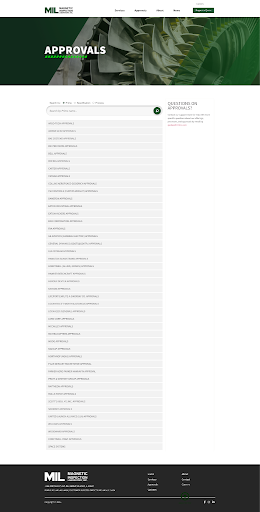
Windmill began with MIL’s strongest and most neglected asset. Our internal web development team built a custom Approvals Table with a supporting taxonomy, creating a scalable structure for classifying and filtering approvals rather than presenting them as a static list. Forty-four dedicated approval pages were created, each targeting the specific OEM and specification queries associated with that approval, with descriptive titles, meta descriptions, introductory content explaining the approval’s requirements and value, and a logical heading hierarchy.
Just as important, an internal linking strategy connected these pages into the main site structure, eliminating the orphan problem and distributing authority across the new section. Windmill also optimized MIL’s homepage and eight core service pages, replacing generic “what is” content with capability-forward messaging, restructuring pages into scannable sections, and updating positioning to lead with what MIL does rather than only who MIL is. A cloud-based reporting dashboard was implemented to give MIL ongoing visibility into performance.
Phase 2: Capability-level pages and a specification taxonomy
With the approvals architecture in place, Phase 2 addressed the service content. Windmill identified each core sub-service beneath MIL’s parent service categories and built 34 dedicated capability pages — Teflon and PTFE coating, Xylan coating, CARC coating, chemical milling, chem film and alodine conversion, aluminum anodizing, passivation, fluorescent dye penetrant, helium leak testing, magnetic particle inspection, and others. Each page received its own keyword targeting, detailed feature and application content, and internal links connecting it to its parent service page and to relevant approvals.
Windmill then built out a custom Specification taxonomy, producing 218 indexable pages so that a buyer searching a bare specification number — the way this audience frequently searches — lands directly on MIL rather than a competitor or a standards database. The development team completed technical SEO remediations addressing crawlability, indexation, and page performance across the site.
Results: Nearly four times the keyword footprint, and organic search became the primary conversion channel
- +278% increase in total organic keyword rankings
- +379% increase in Page 1 keyword rankings
- +419% increase in Top 3 keyword rankings
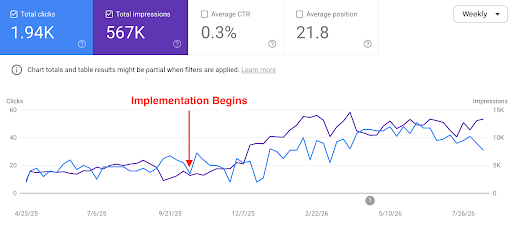
- +102% increase in organic impressions
- +50% increase in organic users
- +383% increase in organic form submissions
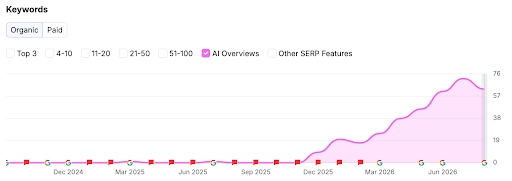
- 70+ keywords surfacing in Google AI Overviews
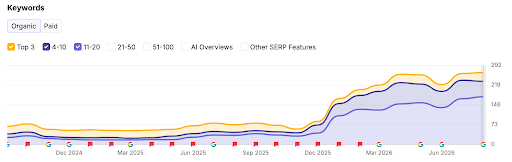
MIL’s keyword portfolio grew from 262 ranking keywords at the start of the engagement to 989 nine months later. Page 1 rankings grew from 39 to 187 and Top 3 rankings from 21 to 109. Organic users grew 50% year over year, and average engagement time per organic user rose 34% — an unusual combination, since audience growth typically dilutes engagement, and one that indicates the new pages were answering the specific technical questions visitors arrived with.
The sub-service capability pages built in Phase 2 were the single largest driver. These pages generated 98,308 organic impressions and 362 clicks in their first full quarter, from a starting point of zero, and now account for 311 ranking keywords with 85 of those on Page 1. The Teflon and PTFE coating page alone earned 40,072 impressions and now ranks second nationally for “ptfe coating,” a term drawing 3,600 searches per month. MIL also holds first-position rankings for “coating ptfe,” “military grade coatings,” “coating stainless steel with teflon,” “faa approved powder coating companies,” and “metallurgical examination,” none of which the site ranked for at all before the engagement.
The same architecture that lifted traditional rankings also made MIL visible in an entirely new channel. At the start of the engagement, MIL’s keywords appeared in zero AI Overviews — the AI-generated answers Google now places above traditional results. Beginning roughly six months into the engagement, that number began climbing, and MIL’s keywords now surface in more than 70 AI Overviews. This wasn’t a separate initiative. AI systems cite pages that answer a specific question with depth and clear structure, and the capability pages, approval pages, and specification taxonomy were built to do exactly that — one page, one topic, thoroughly covered. The result is that when a procurement engineer asks Google (or an AI assistant drawing on the same content) about a niche process or specification, MIL is part of the answer. As more technical buyers begin their research in AI tools rather than a traditional search bar, that early footprint compounds: the structured, capability-level content that wins Page 1 rankings today is the same content large language models retrieve and cite tomorrow.
The Phase 1 approvals work compounded over the same period. Impressions on the approval pages grew 139% and average positions improved dramatically: Boeing moved from an average position of 35th to 8th, Hamilton Sundstrand from 37th to 8th, and Raytheon from 50th to 8th. The specification pages, which produced no traffic a year earlier, now draw steady visits from buyers searching by spec number.
Organic impressions grew faster than organic clicks — 102% against 34% — which is the expected pattern when a site roughly quadruples the number of searches it appears for. Many of the newly ranking keywords sit in positions 11 through 20, where impressions accumulate but clicks are rare. With 163 keywords currently in that band and Page 1 rankings already up 379%, that gap represents click growth still ahead rather than performance lost.
Most importantly, the newfound visibility converted into qualified leads. Organic search produced 116 form submissions in a single quarter, 67 of them quote requests rather than general inquiries. Visitors arriving from organic search submit a form 3.53% of the time, compared with 0.78% for visitors who arrive by typing in the web address directly. Organic search delivered roughly a third of the site’s traffic during the quarter and produced roughly two-thirds of its total form submissions.
For a supplier whose competitive advantage has always been the depth of what it can do and the length of time it has been doing it, the engagement made that advantage legible to the buyers searching for it — turning an 80-year reputation into a measurable source of qualified inquiries.
Windmill Strategy is a web design company & digital marketing agency helping B2B Industrial, Automation & Manufacturing companies achieve increased visibility, higher quality leads, and greater marketing ROI through smarter web design. Our website design and B2B digital marketing approach goes beyond “more traffic,” seeking out better traffic, by gaining the attention of the specific niche groups of buyers and influencers that represent your best customers. We help our clients communicate and sell their complex products and services to multiple audiences – be it through web design or digital marketing and SEO. Working collaboratively with your in-house marketing and sales team, we design websites that drive leads and sales that result in overall business growth. Schedule a call to learn more.